You can read my review of the film Muallaf here, as well as read about my visit to the set here. You can also find out more about the film here when Yasmin and cast were in town for the Singapore premiere. I'm not sure if the DVD can still be found, but here's what it contained as extras.

Sunday, May 31, 2020
Muallaf (The Convert) - Discussion with Film Cast
Hosted by The Center for Global Muslim Life, this was held online about 2 days ago. For fans of Yasmin Ahmad, her cast, and the film, needless to say this is something that should not be missed!
You can read my review of the film Muallaf here, as well as read about my visit to the set here. You can also find out more about the film here when Yasmin and cast were in town for the Singapore premiere. I'm not sure if the DVD can still be found, but here's what it contained as extras.
You can read my review of the film Muallaf here, as well as read about my visit to the set here. You can also find out more about the film here when Yasmin and cast were in town for the Singapore premiere. I'm not sure if the DVD can still be found, but here's what it contained as extras.


Wednesday, January 29, 2014
re:solve / 决议案 Trailer

A little bit more of the story, written by Matthew Ing, Olivia Loh and director Randy Ang, gets teased in the new trailer, though I'll hold my tongue if it seemed a wee bit like...
Trailer:
Teaser:
Bookmark 27 Feb 2014 in your calendar!
Tuesday, January 21, 2014
Protect Citizens of Straight Laced Singapore with Rubbers!

And when your favourite filmmakers make an appeal, you want to help in any way you can.
Hence, Rubbers (套).
I chanced upon this film when the creative folks at 18g Pictures were incubating it sometime circa 2012, picking up a promotional postcard (at the Hong Kong International Film Festival), emblazoned with that picture you see right at the top of this post. It's kinda naughty, grabs your attention, and you wonder just what's brewing in the minds of the filmmakers.
After all, it's a sex-comedy. Heck, just that genre alone has piqued my interest since we're already done with horror-comedies, with a slate of bad genre films to have hit our shores in recent years.
Some details about Rubbers (套) have been released, that it's a collection of three short stories centred around love, seduction and punishment. The film's 2/3 done, and needs some fresh injection of funds to see it through completion. You can listen / watch director Han Yew Kwang make his appeal at Indiegogo, together with familiar faces in the 18g Pictures stable:
So, DONATE. You know you want to. Even if it's just to make the censors here work hard at tripping over themselves and getting all flustered when it comes to rating it.
But more importantly, this country deserves a vastly different voice in defining its comedies, rather than the same-old boring formula by the usual suspects. A little quirkiness doesn't hurt at all!
And 18g Pictures, has my vote of confidence to do just that.
Oh, and if you need more convincing, hit the Rubbers's Indiegogo page to see what the newly minted 50th Golden Horse Best Supporting Actress would be up to in the film. Don't say that good things never share, OK?
Wednesday, January 01, 2014
2014 Singapore Movies
Friends, this is to keep track of Singapore movies (made by Singapore Filmmakers / selected co-productions) screened, or going to be screened, for this year - 2014.
Do check back for periodic updates, as and when I discover them.
Or help me! If you know of those not in my list, please let me know?
Or if you're a filmmaker and have an upcoming project, would you grant me the opportunity of trying to add a little buzz to it?
Mucho Gracias!
The Lion Men / 狮神决战 - Jack Neo, Jan 2014

Trailer:
re:solve (决议案 / Jue Yi An) - Randy Ang, Feb 2014
Teaser:
Trailer:
Justice Devil / The Magnum (Working Title) - C.J.Harvaraj

Trailer:
(Magnum) Trailer:
3.50 - Eysham Ali & Chhay Bora, Feb 2014
3688 / 想入飛飛 - Royston Tan, 2014

As You Were - Liao Jiekai, 2014
Filial Party / 我是孝子 - Boris Boo, May 2014
Afterimages - A Collection of Horror Films From Hell - Tony Kern, 2014
Teaser (Ghost Pool Leg):
Trailer:
Banting - M Raihan Halim, 2014
Camera - James Leong, 2014
FaeryVille - Tzang Merwyn Tong, 2014
I Am Jonathan - David Liu & Kelvin Sng, 2014

I Want You / 中国好声音之为你转身 - Chai Yee-Wei, China Dec 2013, Singapore 2014
Little Medium Boy / 小灵媒 - Meng Ong, 2014
Meeting the Giant / 再见巨人 - Tay Ping Hui, 2014
Mister John - Christine Molloy and Joe Lawlor, 2014
The Obs: A Documentation - Yeo Siew Hua, 2014
Rubbers / 套 - Han Yew Kwang
Sayang Disayang / Ramuan Rahasia / The Missing Ingredient - Sanif Olek, SalaMindanaw International Film Festival 2013, Singapore 2014
Teaser:
Showreel 1:
Showreel 2:
To Singapore, with Love / 星国恋 - Tan Pin Pin, Busan International Film Festival Oct 2013

Wukan: The Flame of Democracy - Lynn Lee & James Leong, 2014

A Yellow Bird - Kesavadas S/O Rajagopal, 2014
Zombiepura - Jacen Tan, 2014

(aka Announced / Development Hell / Pre-Production / Post-Production / Release TBA / etc)
1021 - Vicknesh Saravanan
1400 - Derrick Lui
1965 - Homerun Asia
32 - Eric Khoo
A Bit of Earth - Lee Thean-jeen (Raintree)
A Million Monkeys - Sun Koh
Ah Boys To Frogmen - Jack Neo
Ah John - Jeremy Sing
Apprentice - Boo Junfeng
The Arrival - Tan Pin Pin
Banting - M Raihan Halim
BasketBallet - Nicholas Chee
Bed - Kelvin Tong
Betok - Sherman Ong
Black Box - Militancy Pte Ltd
Bookmarked - Wesley Leon Aroozoo
Breakfast, Lunch, Dinner - Tay Bee Pin
Bringing Back the Dead / 招魂 - Lee Thean-Jeen
Broadway Beng Movie - ?
Bye Bye Ghosts! - Han Yew Kwang

Building Waves / 溺 - Rick Aw
Causeway - Alson Ho
The Charming Rose / Chinese Rose - Eric Khoo
The Chase - Homerun Asia/Clover Films
Cloudcuckooland - Ho Tzu Nyen
Coffee Roses - Cheng Ding An
Come Home Grandma! - Rajendra Gour
The Confinement Nanny - Teo Eng Tiong
Dayak Brothers - Kelvin Sng
Dystopia - Jeevan Nathan, Mike Chew, Christina Choo, Boi Kwong, Randy Ang, Ric Aw, Bernard Tan, Lawrence Ong, Terence Teo, Nicholas Chu
East of Aden - Marcus Lim
Email - Kelvin Tong
Endless Day - Ho Tzu Nyen
Eter9ity / 天长地9 - Kelvin Sng

Fabulous Fat Fish - Cubix International, 3D Animated (from the makers of Zodiac and Legend of the Sea :P)
Fallen - Lillian Wang
Fang - Wee Li Lin
The Flying Postman - Han Yew Kwang

FM - Mediacorp Raintree Radio Movie
Forgotten Tears - Ellery Ngiam
Fuck Me Dead - Eric Khoo
The Gene Generation - Pearry Reginald Teo

Trailer:

Get Meaty - Han Yew Kwang
Ghost Bride - Sam Loh
Ghostwriter - Cheng Ding An
Go, Thaddeus! - Yasmin Ahmad
Granny Neo (Animated) (2011) - Jack Neo?
The Hangman's Breakfast - Glen Goei
Happy April's Fool - Kah-Beng
Hinterland - Tan Pin Pin
Homeland - Marcus Lim
I Am Thinking Of You - Elizabeth Wijaya & Lai Weijie
I Not Stupid - China - Jack Neo
The Immigrant Story - (Bad Alliteration Films)
In The Room - Eric Khoo
Jam - ? (Pics Talk)
The Kids Who Went To Jail - James Leong and Lynn Lee
Koi - Mika G Yamaji
Kung Fu Gecko the Movie - Egg Story Creative Production
Little Medium Boy = Ong Meng
Look Both Ways - Yong Mun Chee
Love Me Tender, Love Me Fat - Han Yew Kwang

Maid To Order - Djinn
Matahari - Azharr Rudin
Mei Meng - Ernest Goh and Randy Ang
Men Look Women See - ? (Sinema Incubator Programme)
Merry Gold Round - A.I. Pictures
Migrant Workers - James Leong and Lynn Lee
Monsoon Murders - Kelvin Tong
More Than Words - Kelvin Sng
Ms J Contemplates Her Choice - Jason Lai
My Life In Heels - Militancy Pte Ltd
Nadra - Sarah Lambert
The Nail - Mike Wulian
Night Lights - Daniel Hui
Notes From An Expat The Movie - Lionel Chok

Our Sister Mambo - Ho Wi Ding
Perkataan Cinta - Shahrezza Zuhri
Pickles - JK Saravana
Trailer:
Pinball - Han Yew Kwang
Pontianak The Movie - Chai Yee Wei
Protect, My Love - Leonard Lai
The Rapists Wore Blue Hats - Amit Virmani
Real Fiction - Han Yew Kwang
Redhill Close - Lei Yuan Bin
Rooms - Void Deck Films
Rough Mix - ?
School in the Sky - Dennis Wong & Dorji Wangchuk
The Seminarian - Joshua Lim
Seven: The Spirit Returns - Foo Fung Koon
Seven Days - Mirtillo Films
The Shortest Man in the Village Who Can Soar Like an Eagle - James Leong and Lynn Lee
Trailer:
Sinema - Tan Ai Leng
Singapooru - Abbas Akbar
Singapore Cowboy - Wee Li Lin
Singapore Girl - Kan Lume
Six "Brave" Warriors - Jack Neo
Silver Ring - Wong Kuang Yong
Sinema Paradiso - Tan Ai Leng
So This is Christmas - Void Deck Films
Styrofoam Samurai - Cheng Ding An
Taller Than Yao Ming - (Raintree)
Third Eye Open - Tony Kern
They Call Her ITCHY BITCH - Void Deck Films
Thunder Boys - Alaric Tay
Titoudao - Goh Boon Teck
Unsettled - A.I. Pictures
Untitled Eunice Olsen Film - TBC
Untitled Geoffrey Malone Science Fiction Black Comedy - Geoffrey Malone
Untitled Glen Goei Movie Set In Australia - Glen Goei
Untitled Harry Yap Movie - Harry Yap
Untitled Lionel Chok Project - Lionel Chok
Untitled Russel Wong Movie by 2011 - Russel Wong
Untitled "Study Mothers/Pei Du Ma Ma" Project - Kelvin Sng
Untold Beauty - Roy Lim
Vengeance of Cleopatra - ?
V O L U P T A S - Sanif Olek
Teaser:
Wild Dog Chase - Homerun Asia
WSB Executive Assistant - Randy Ang
Yellow Flowers - Glen Goei
The Youth - Clover Films
Zeroes to Heroes - ? (AI Films)
Do check back for periodic updates, as and when I discover them.
Or help me! If you know of those not in my list, please let me know?
Or if you're a filmmaker and have an upcoming project, would you grant me the opportunity of trying to add a little buzz to it?
Mucho Gracias!
Feature Films
The Lion Men / 狮神决战 - Jack Neo, Jan 2014
Trailer:
re:solve (决议案 / Jue Yi An) - Randy Ang, Feb 2014
Teaser:
Trailer:
Justice Devil / The Magnum (Working Title) - C.J.Harvaraj
Trailer:
(Magnum) Trailer:
3.50 - Eysham Ali & Chhay Bora, Feb 2014
3688 / 想入飛飛 - Royston Tan, 2014
As You Were - Liao Jiekai, 2014
Filial Party / 我是孝子 - Boris Boo, May 2014
Afterimages - A Collection of Horror Films From Hell - Tony Kern, 2014
Teaser (Ghost Pool Leg):
Trailer:
Banting - M Raihan Halim, 2014
Camera - James Leong, 2014
FaeryVille - Tzang Merwyn Tong, 2014
I Am Jonathan - David Liu & Kelvin Sng, 2014
I Want You / 中国好声音之为你转身 - Chai Yee-Wei, China Dec 2013, Singapore 2014
Little Medium Boy / 小灵媒 - Meng Ong, 2014
Meeting the Giant / 再见巨人 - Tay Ping Hui, 2014
Mister John - Christine Molloy and Joe Lawlor, 2014
The Obs: A Documentation - Yeo Siew Hua, 2014
Rubbers / 套 - Han Yew Kwang
Sayang Disayang / Ramuan Rahasia / The Missing Ingredient - Sanif Olek, SalaMindanaw International Film Festival 2013, Singapore 2014
Teaser:
Showreel 1:
Showreel 2:
To Singapore, with Love / 星国恋 - Tan Pin Pin, Busan International Film Festival Oct 2013
Wukan: The Flame of Democracy - Lynn Lee & James Leong, 2014
A Yellow Bird - Kesavadas S/O Rajagopal, 2014
Zombiepura - Jacen Tan, 2014
Others in the horizon
(aka Announced / Development Hell / Pre-Production / Post-Production / Release TBA / etc)
1021 - Vicknesh Saravanan
1400 - Derrick Lui
1965 - Homerun Asia
32 - Eric Khoo
A Bit of Earth - Lee Thean-jeen (Raintree)
A Million Monkeys - Sun Koh
Ah Boys To Frogmen - Jack Neo
Ah John - Jeremy Sing
Apprentice - Boo Junfeng
The Arrival - Tan Pin Pin
Banting - M Raihan Halim
BasketBallet - Nicholas Chee
Bed - Kelvin Tong
Betok - Sherman Ong
Black Box - Militancy Pte Ltd
Bookmarked - Wesley Leon Aroozoo
Breakfast, Lunch, Dinner - Tay Bee Pin
Bringing Back the Dead / 招魂 - Lee Thean-Jeen
Broadway Beng Movie - ?
Bye Bye Ghosts! - Han Yew Kwang
Building Waves / 溺 - Rick Aw
Causeway - Alson Ho
The Charming Rose / Chinese Rose - Eric Khoo
The Chase - Homerun Asia/Clover Films
Cloudcuckooland - Ho Tzu Nyen
Coffee Roses - Cheng Ding An
Come Home Grandma! - Rajendra Gour
The Confinement Nanny - Teo Eng Tiong
Dayak Brothers - Kelvin Sng
Dystopia - Jeevan Nathan, Mike Chew, Christina Choo, Boi Kwong, Randy Ang, Ric Aw, Bernard Tan, Lawrence Ong, Terence Teo, Nicholas Chu
East of Aden - Marcus Lim
Email - Kelvin Tong
Endless Day - Ho Tzu Nyen
Eter9ity / 天长地9 - Kelvin Sng
Fabulous Fat Fish - Cubix International, 3D Animated (from the makers of Zodiac and Legend of the Sea :P)
Fallen - Lillian Wang
Fang - Wee Li Lin
The Flying Postman - Han Yew Kwang
FM - Mediacorp Raintree Radio Movie
Forgotten Tears - Ellery Ngiam
Fuck Me Dead - Eric Khoo
The Gene Generation - Pearry Reginald Teo
Trailer:
Get Meaty - Han Yew Kwang
Ghost Bride - Sam Loh
Ghostwriter - Cheng Ding An
Go, Thaddeus! - Yasmin Ahmad
Granny Neo (Animated) (2011) - Jack Neo?
The Hangman's Breakfast - Glen Goei
Happy April's Fool - Kah-Beng
Hinterland - Tan Pin Pin
Homeland - Marcus Lim
I Am Thinking Of You - Elizabeth Wijaya & Lai Weijie
I Not Stupid - China - Jack Neo
The Immigrant Story - (Bad Alliteration Films)
In The Room - Eric Khoo
Jam - ? (Pics Talk)
The Kids Who Went To Jail - James Leong and Lynn Lee
Koi - Mika G Yamaji
Kung Fu Gecko the Movie - Egg Story Creative Production
Little Medium Boy = Ong Meng
Look Both Ways - Yong Mun Chee
Love Me Tender, Love Me Fat - Han Yew Kwang
Maid To Order - Djinn
Matahari - Azharr Rudin
Mei Meng - Ernest Goh and Randy Ang
Men Look Women See - ? (Sinema Incubator Programme)
Merry Gold Round - A.I. Pictures
Migrant Workers - James Leong and Lynn Lee
Monsoon Murders - Kelvin Tong
More Than Words - Kelvin Sng
Ms J Contemplates Her Choice - Jason Lai
My Life In Heels - Militancy Pte Ltd
Nadra - Sarah Lambert
The Nail - Mike Wulian
Night Lights - Daniel Hui
Notes From An Expat The Movie - Lionel Chok
Our Sister Mambo - Ho Wi Ding
Perkataan Cinta - Shahrezza Zuhri
Pickles - JK Saravana
Trailer:
Pinball - Han Yew Kwang
Pontianak The Movie - Chai Yee Wei
Protect, My Love - Leonard Lai
The Rapists Wore Blue Hats - Amit Virmani
Real Fiction - Han Yew Kwang
Redhill Close - Lei Yuan Bin
Rooms - Void Deck Films
Rough Mix - ?
School in the Sky - Dennis Wong & Dorji Wangchuk
The Seminarian - Joshua Lim
Seven: The Spirit Returns - Foo Fung Koon
Seven Days - Mirtillo Films
The Shortest Man in the Village Who Can Soar Like an Eagle - James Leong and Lynn Lee
Trailer:
Sinema - Tan Ai Leng
Singapooru - Abbas Akbar
Singapore Cowboy - Wee Li Lin
Singapore Girl - Kan Lume
Six "Brave" Warriors - Jack Neo
Silver Ring - Wong Kuang Yong
Sinema Paradiso - Tan Ai Leng
So This is Christmas - Void Deck Films
Styrofoam Samurai - Cheng Ding An
Taller Than Yao Ming - (Raintree)
Third Eye Open - Tony Kern
They Call Her ITCHY BITCH - Void Deck Films
Thunder Boys - Alaric Tay
Titoudao - Goh Boon Teck
Unsettled - A.I. Pictures
Untitled Eunice Olsen Film - TBC
Untitled Geoffrey Malone Science Fiction Black Comedy - Geoffrey Malone
Untitled Glen Goei Movie Set In Australia - Glen Goei
Untitled Harry Yap Movie - Harry Yap
Untitled Lionel Chok Project - Lionel Chok
Untitled Russel Wong Movie by 2011 - Russel Wong
Untitled "Study Mothers/Pei Du Ma Ma" Project - Kelvin Sng
Untold Beauty - Roy Lim
Vengeance of Cleopatra - ?
V O L U P T A S - Sanif Olek
Teaser:
Wild Dog Chase - Homerun Asia
WSB Executive Assistant - Randy Ang
Yellow Flowers - Glen Goei
The Youth - Clover Films
Zeroes to Heroes - ? (AI Films)
Friday, September 27, 2013
Innocents

Heading Somewhere
While accolades are going Anthony Chen's and Ilo Ilo's way, there's another award winning film that's just been released and screening at The Arts House under its Frame X Frame banner. Producer-Director-Writer Wong Chen-hsi received Best Director at the Asian New Talent Award at last year's Shanghai International Film Festival, and like Ilo Ilo, the film finally found its way home from the overseas festival circuit, for local audiences to savour and celebrate its acclaimed success with our homegrown talent.
But unlike Ilo Ilo's context and story, which is by far the more accessible and powerful one, Innocents turned out to be a rather abstract affair, dealing with loneliness and the ostracizing of children who by chance, found their way to each other's company despite early animosity and difference, to fiercely forge a firm friendship between them cemented by a secret shared, which like all good things, rarely last. But therein lies the issue with Innocents because it didn't really allow for a genuine audience connection with the children involved, accompanying them in their growing pains, and this made it easy to turn off especially when scenes seemed to be over-indulging in its capture of beautiful green scenery, and other carefully composed shots.
The opening shot with its widescreen aspect ratio presentation throughout, is set to wow with its first impressions, and the technical details were nothing less than top notch. Images were engineered to be postcard picturesque especially when it had to do with the wide outdoors of natural forest and foliage, cut through by railway track (now defunct) and concrete monsoon drain, all of which serve as the truancy playground for the primary schoolchildren of Syafiqah (Nameera Ashley) and Huat (Cai Chengyue). Which seemed to go on almost forever for half the film, while at the same time peppering the narrative with suggestions of their troubled backgrounds. Their new found landscapes, hidden from the adult world that didn't seem to understand them, provide temporal relief and an avenue where they can just be kids, playing with water, catching fish, and hiking, but somehow the narrative started to languish, until the midpoint of a discovery that teased, but frankly didn't get developed.
It was a little bit peculiar that the context, time and places can't be deliberately pin-pointed in the film. It can only be assumed it's set in Singapore (although frankly it could be anywhere in and around Malaysia for a shot of a KTM map) - the only giveaway was the old currency used - with its kampung house complete with leaky rooftops, contrasted with high rise HDB flats. But other issues like the way buses operate, threw this assumption off track from time to time. And to work around its budget, an excellent sound design by Vincent Tang compensated for the visuals, or lack thereof, for instance, cueing us that it's a full fledged, busy school, when what can be mustered for the screen showed otherwise. Cinematographer Joseph White also had a hand in making the film look gorgeous for the most parts, but once you're past all the technical brilliance, you're left on your own to seek out that soul which was conspicuously absent.
For a while, the story felt like My Neighbour Totoro done live-action style in some parts, with the kids going off playing in a little wonderworld of greenery, oblivious to time and space, and even had to depend on a private bus as transportation to and from locations. But it is not all fun and games as the story starkly contrasted some unreal situations, at least when seen today, where teachers can no longer be tyrants and hold the final word in class. It's yet another clue this may have been set in yesteryear, as any educator can attest to the losing of jobs should anyone raise hell the way the teacher did as portrayed in this film. And the story wastes no time in demonizing most of the adults save for one science teacher, while most of the male students got shoe-boxed as bullies who make life difficult for Huat.
One hardly gets a Malay girl in a local film as a leading protagonist (the last film that did that was perhaps Marc X Grigoroff's Salawati back in 2008), and here, Nameera Ashley provides a doe-eyed, smart lass portrayal in her Syafiqah, undoubtedly the dutiful good student who knows her stuff, and doesn't stand for any nonsense from anyone. And Cai Chengyue plays her opposite number as the unkempt boy who persistently comes to class late, which makes his teacher constantly tear her hair out, and exasperated by his couldn't-care-less attitude. One's a newly transfered student, while the other is the resident troubled boy, and it's no sooner that both find some common ground and connection to each other.
However, it is their scenes together where they say nothing at all, except to let their actions do the talking, that worked. Otherwise what made this movie seem a little bit artificial, is the quality of the dialogues, which contain too much polish that you would not expect to have come out from children. Not to diss them as incapable of doing so, but the sentences that came out of both children, seemed to be nothing more than elaborate mouthpieces for the storyteller, with the kids seemingly spouting lines that were comfortable for a stage play, but being really out of place and awkward for something on film. The intent may be to show that the kids were more mature in their thinking and actions when it came to the big picture, while the adults were petty and unreasonable, but it's a pity that this didn't get naturally coaxed out from the performers, making scenes look too engineered, rote, and lifeless.
Innocents may be a visual feast, but it isn't something that's already not seen before in a local film, with similar prominent landscapes already covered in quite detail through an early film in Liao Jiekai's Red Dragonflies. Narratively it didn't manage to cement emotional depths for connection with its leading characters, and the story sort of gave way toward its final third when left to the devices of a solo character to lead the charge. If it was more direct and bold with its intent, rather than to leave it as an open end, then perhaps it would have provided the film with that edge it sorely needed. Still, it's an A for technical effort, if only it had a story with a stronger emotional core to back it up. Singapore's top supporting actor Lim Poh Huat is in the film as well, though you don't get too see or recognize him much in the movie until the end credits roll.
Thursday, September 26, 2013
ILO ILO (爸妈不在家 / Ba Ma Bu Zai Jia)

Family Matters
Who would have guessed that Singapore's film of the moment, and possibly of this year, has its English title refer to a location outside of the little red dot, a city that was never even mentioned in the film. And this was also the case for its Chinese title, although the phrase was possibly the key reason why its youngest key character got up to his shenanigans for the most parts, reflecting a social norm for double income families in the city state, where kids are often left growing up under the watchful eyes of domestic workers instead.
We had to wait until some 7 years after Singapore Dreaming, before another powerful local family drama get to grace our screens, a genre few filmmakers dare touch, since it may be perceived that Singaporeans dislike holding that mirror up at ourselves, or that it's easier to satire or poke fun at some social issues through comedy for the masses, which most of the lucrative local film releases here fall under. And here came writer-director Anthony Chen, already a trailblazing short film filmmaker, who showed his maturity as a storyteller, combining narrative eloquence with deft, effective techniques to tell a personal tale set against an historical background, much like a combination of his best known shorts Ah Ma, a Cannes Special Mention previously that centered around grieving family members, and Haze, which had the environmental hazard serve as the backdrop of a "Ba Ma Bu Zai Jia" situation.
To be honest I had some doubts when Ilo Ilo's trailer premiered, thinking that we could be staring down Singapore Dreaming Part Deux given perceived similarities in cast and some subject matter, even as the film moved along, such as how lottery still found its way to the plot (as did most other local films to varying degrees), and an expectant mother character that actress Yeo Yann Yann plays, although this time it was for real with the actress pregnant, and had it worked into the plot by the filmmaker. And my suspicion that this could be Tokyo Sonata, with the father figure losing his job, and other very personal story arcs revolving around the other key characters, got blown away as soon as the film entered its initial minutes, that this was already something different, and groundbreaking in the making as far as local films are concerned.
As it turned out, this is Anthony's labour of love, and the tremendous attention to detail was simply amazing, though not perfect (but what is?), with its art direction to immerse the viewer into knowing we're in the mid 90s without the need for an obvious marker until mid way. Electronic devices such as the Tamagochi game which was quite the rage in its time, ubiquitous pagers, and Sony's walkman all serve to remind us of a time where we got by without feeling the need to be online all the time. And from these little gadgets, come the darting of one's eyes to a lot more clues of time, from costuming right down to wide angled shots where I just had to find something out of place, but rarely did (I admit I nodded when a wide shot of a school hall had the correct President and First Lady picture hung up, something which could have been easily overlooked, amongst other things such as the model used for a police car).
But it is economical filmmaking in a sense, yet big in ambition to tell a story that can, and has proven, to resonate with audiences around the world. Most of the scenes take place in family HDB apartment, or the school, and any other outdoor shots were meticulously scouted and could have made the Old Places team proud, especially when we're modernizing our landscapes at a frightening pace. And the cinematography exploits tight spaces in lieu of avoiding getting something out of place into the frame, yet through its technical constraints came an intimate portrait through tight shots and intricate framing.
What I really liked about the film is how effortlessly the narrative flowed, without the director feeling the urge to be verbose about everything, preferring set ups to be resolved naturally at a later stage, with the film taking its time to evolve rather than pushing its pace to a rush, reining in any attempt to be overly ambitious in trying to cover everything, catalyzed from the introduction of a stranger into a family's life. And on top of that, giving each character crafted their strong, personal story arcs whose challenges one can surely feel for since they touch raw nerves from an unforgettable 90s era.
The Singapore Dreaming connection cannot be stronger than with Yeo Yann Yann's presence playing a pregnant mom in a family drama. One of the actresses at the top of her craft plying her trade on both sides of the Causeway, it is needless to say her sheer acting prowess shone through a role that required her to respond to threats, where her character had to witness the erosion of her bond with her son who slowly but surely begin to forge a stronger one with their family maid. And if that's not challenging the actress enough, her role also deals with the albatross of retrenchment starkly happening in the local small and medium enterprise her motherly character works for, and finding belief through self-help materials.
I've never thought much about Chen Tianwen as an actor since his television days, but it's a testament to the director's ability to elicit the best performance possible from his cast, and it's indeed a revelation that this actor could act, if given the right role, and having his ability coaxed right out of him. While the character had to disappear for a bit toward the last act, his Mr Lim stood for how the typical father would under dire circumstances, speaking little, and digging deep from within to weather the storm, picking up any job to tide through tough times. If you, like me before who is unconvinced by Chen Tianwen's acting abilities, you're in for a huge and pleasant surprise.
Fans of Lav Diaz's films would be no stranger to Angeli Bayani, who plays Teresa/Terry the maid, and nailed her role through and through as the dutiful servant with a mind of her own, standing up for herself from the onset when bullied. Leaving her family and young son behind, the character echoes many of those under similar circumstances, having to come to our island to look after someone else's kid instead, while at the same time bearing witness to the secrets each household owns. And rounding up the principle cast members is Koh Jia Ler as the young kid of the Lim family Jiale, a rascal of a kid, spoilt in a sense, and being the bane of Teresa at the start. Ilo Ilo has their story arcs central to everything else happening around them, and the chemistry between these two performers was one of the highlights of the movie, as we journey through their changes in attitudes that gave way to mutual respect, and love. Probably the child actor at the moment, having to co-shoulder the weight of the film on his shoulders as the unlikely antagonist who jump starts situations.
Ilo Ilo is a subtle, sensitive film, boiled down to a filmmaker's maturity and strength in peppering plenty of life's observations, combined with personal experiences, poured into a melting pot full of heart. Amongst the local film releases this year, this one is a refreshing change to the usual faces seen on screen, dealing with themes that will definitely strike a chord, which when stripped down, points to desires in enriching oneself for various reasons altruistic or otherwise, yet even more keenly felt during poor economic conditions, through methods that are hard and patient, or through short cuts that are illegal, fashioned after self-styled self-help gurus.
Anthony Chen has thrown the gauntlet down for local filmmakers to raise their own bars in filmmaking, leading the charge of the next generation of filmmakers who have their unique vision and stories to tell. It's rare in our filmmaking community to find storytellers who straddle between art house and commercial films, but Ilo Ilo shows that a combination of both is possible. So while the film continues to make waves overseas, and prestigious, international awards aside, there's nothing but true testament for any filmmaker, than for audiences in the home country to respond to the film in a show of support through a ticket. And it's not blind promotion - Ilo Ilo is the best local film to hit our shores this year, and perhaps in recent years, that it deserves as wide an audience as it can get from Singapore. You'll laugh, cry and will invariably be moved. A definite recommend!
P.S. it's been playing for some time already in cinemas, and now it's reduced to limited screenings, so catch it before it disappears from the big screens. This is one movie that has enough reserves in its tank to appeal to a broad spectrum of society, and I'm heartened to have noticed from my evening screening, families turning up in droves to lend support, and emerging satisfied with such a fine film when the lights get turned on.
Saturday, May 18, 2013
Life's Priorities
This is one of those rare blog entries that isn't a film review. I've done that in the past, but those were few and far between.
I thought I could carry this on indefinitely, writing these reviews for pleasure, which had opened some incredible doors for the good part of my life in the past decade or so. The galas, the premieres, the parties, the festivals, and best of all, getting to meet and know a lot of people from all corners of the globe, some of whom I have the privilege of knowing on a personal level, and proud to call them friends. And to do a stock take and look back, it's been one heck of a ride, and I'm thankful for everything that had happened, both the good (that made this life journey interesting) and the bad (hopefully brought out some character).
These are memories that are cherished, but alas there comes a point in time when one has to refocus on life's priorities. Stop and smell the roses so to speak. Where from out of the blue came that proverbial bolt of lightning, changing the game in more ways than one. For the good part of this month I was distracted, but in a good way, as I embark on another part of my life with someone I truly care about.
Trance was probably the last proper review that I did, and I'm embarrassed to say the recent ones after that aren't up to the scratch. And I've got an uncharacteristic backlog that should hopefully see the light of day soon.
I'm not totally disappearing, far from it I suppose, but it's nothing quite unexpected as I had seen this coming when I first started out. And like everything one starts, there's got to be a Plan B. I'd say to return to this blog's original intent that never really quite took off, to focus on local films. That Singapore commercial, or more importantly, indie film that is screaming for a chance to be heard, for its place amongst an unforgiving crowd. Let's do that. And I suppose that odd, occasional review from outside this little red dot, if time permits, and for films I feel strongly about, will pop up occasionally.
So see you at the movies. Although this time, I'm likely with someone special in tow, so come up and say Hi!
I thought I could carry this on indefinitely, writing these reviews for pleasure, which had opened some incredible doors for the good part of my life in the past decade or so. The galas, the premieres, the parties, the festivals, and best of all, getting to meet and know a lot of people from all corners of the globe, some of whom I have the privilege of knowing on a personal level, and proud to call them friends. And to do a stock take and look back, it's been one heck of a ride, and I'm thankful for everything that had happened, both the good (that made this life journey interesting) and the bad (hopefully brought out some character).
These are memories that are cherished, but alas there comes a point in time when one has to refocus on life's priorities. Stop and smell the roses so to speak. Where from out of the blue came that proverbial bolt of lightning, changing the game in more ways than one. For the good part of this month I was distracted, but in a good way, as I embark on another part of my life with someone I truly care about.
Trance was probably the last proper review that I did, and I'm embarrassed to say the recent ones after that aren't up to the scratch. And I've got an uncharacteristic backlog that should hopefully see the light of day soon.
I'm not totally disappearing, far from it I suppose, but it's nothing quite unexpected as I had seen this coming when I first started out. And like everything one starts, there's got to be a Plan B. I'd say to return to this blog's original intent that never really quite took off, to focus on local films. That Singapore commercial, or more importantly, indie film that is screaming for a chance to be heard, for its place amongst an unforgiving crowd. Let's do that. And I suppose that odd, occasional review from outside this little red dot, if time permits, and for films I feel strongly about, will pop up occasionally.
So see you at the movies. Although this time, I'm likely with someone special in tow, so come up and say Hi!
Tuesday, May 14, 2013
Spring Breakers
New World Order
Babes gone bad. A simple enough premise, set around teenyboppers who just cannot wait to break their goody-two-shoes mould, and take on something grittier on film. Written and directed by Harmony Korine, Spring Breakers is that film you may feel nauseous when sitting through, no thanks to its psychedelic colours, repetitive voiceovers, in your face camera angles, and non linear chronological presentation that seemed high on moving backward and forward to rock your cognitive balance deliberately, providing that first hand experience on the perpetual state of high the characters all seem hooked on in their search for hedonism and narcotic nirvana.
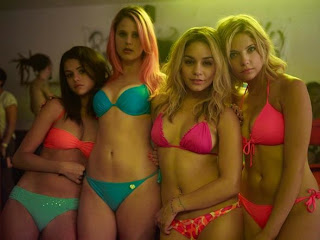
It's like a guys wet dream fantasy come alive when dealing with characters who are uninhibited in wanting to try crazy stuff, and the story follows four college girls - Candy (Vanessa Hudgens), Brit (Ashley Benson), Cotty (Rachel Korine, wife of the writer-director) and Faith (Selena Gomez), the latter playing that religious girl enticed into the life of hard partying by friends who resorted to robbing a restaurant to fuel their spring break vacation. Then it's scene after scene of merry making, sometimes with the aid of drugs, that we see the drowning of values within Faith as she falls deeper into the rabbit hole of trouble.
Faith may be the character differentiated enough from the rest of her friends, but it's a little bit limited to what she can do, given the subject of peer pressure. The others were bland one-dimensional characters who bond deeper because of their clique that had survived an almost impossible pulling off of a robbery, catching the eye of Alien (James Franco), who decided to help the girls out of jail, posting their bail and taking them under his crooked wing.
James Franco stood out for being the thorn amongst the warped roses, and credit to the makeup and wardrobe team for completely knocking off his good looks, and replacing it with a gangsta inspired wardrobe with metallic braces, sun shades and plenty of tattoos. But the outfit doesn't make the character, and Franco owns it as Alien, a rapper cum drug dealer/distributor, complete with small army and a fortune to go on the recruitment hunt that would put the fun-seeking girls in his predatory path.
It's ultimately light in treatment, trying its best to ramp up the final act with the introduction of a gang rival, and the extent of rot the girls descended into, courtesy of the seduction from the dark side. There's little pleasure obtained from watching the movie, like a desperate exercise by the cast to show off how nasty they can actually be for film, playing to the fantasy of the filmmaker.
Saturday, May 11, 2013
The Call

Anticipation
You'd have a fair idea just how this film would transpire from beginning to the end no thanks to its verbatim approach adopted by the trailer, which does the film no justice, leaking out every little detail, key scenes, and identifying all the major characters in the movie, giving away some supporting characters' demise as well. So what's left in the movie that would make anyone want to sit through and watch it?
Maybe it's the performances of its Academy Award winner and nominee in Halle Berry and Abigail Breslin, which the trailer also never fail to remind you of their acting pedigree, as if hinging on their past successes in order to guarantee this one. But even their experience alone can't salvage Richard D'Ovidio's story, which is kept simple, despite having an interesting premise to work on, in the centralized control centre of all 911 emergency calls in Los Angeles. It was worked well into the story as a prologue with Berry's Jordan Turner playing an emergency phone responder, and having things go down south when she's distracted and not composed in her role, causing the death of her caller (no worries, this already covered in trailer territory).
Now months later, she's no longer in the frontlines, but adopted the trainer role in induct new joiners to the occupation, explaining the job hazards and providing a lot more detail that serve as interesting nuggets of information to the audience, but little else, before the serial killer (Michael Eklund) strikes again, this time abducting Casey Welson (Breslin) from a mall's parking lot, before putting her in the boot and driving off. A cat and mouse game ensues, with Casey having in possession a pre-paid cellphone, can only feed off to the cops some bits and pieces of information, while the killer continues to violently thwart every obstacle put in his way.
There are little thrills and spills in the narrative no thanks to the trailer for just about leaking the entire story in under 3 minutes. It did however, keep the motivations of the killer at bay, although what's being revealed is neither shocking since it's somewhat expected. The kicker though, turned out to be the final few mintues, which plays completely out of character, yet in it because you know director Brad Anderson needed something more intelligent, and this was a random grasp amongst straws for anything that can be turned into a story about revenge and just desserts.
Friday, May 10, 2013
The Big Wedding

Disaster
This could have been a fine romantic comedy and heartwarming family drama, but it turned out to be nothing more than an extension of its trailer, having revealed the entire plot, and a total waste of talent at its disposal. Directed by Justin Zackham, who also adapted the screenplay from the 2006 French-Swiss movie Mon Frere Se Marie, The Big Wedding is light on laughs, and even lighter in its dramatic, emotional moments, making it cold and distant, and never quite achieving anything in its featherweight treatment.
Imagine the likes of Robert De Niro, Katherine Heigl, Diane Keaton, Amanda Seyfried, Topher Grace, Susan Sarandon and Robin Williams in your cast list. Filmmakers will kill to get a fraction of that talent in their movies, and Zackham showed prime example just how to flush everyone down the toilet. It's true that if you get good talent, it's half the job done, but being unable to manage and direct, exposed how everyone can just go through the motions to get that paycheck for bill payments. Clocking at less than 90 minutes, everyone has a little bit of screen time, just to turn up, play their caricatures, then retire into the sunset. The premise was set, but hardly anything of note happens, with convenience pretty much summed everything up, and its supposed surprises being pulled off as desperate attempts to add flavour to the mix.
De Niro plays Don, who has for many years divorced his wife Ellie (Keaton), and is now in a relationship with Bebe (Sarandon). They all get together when their adopted kid Alejandro (Ben Barnes) is about to get married to Missy (Seyfried), and one would expect hilarity to ensue because of the clash of characters, and hidden agendas amongst all players. Then there's the big lie they have to put up with, because Alejandro's biological mother Madonna (Patricia Rae) is scheduled to attend his wedding, but seriously, at this point, everything had sounded terribly tedious.
The narrative then tried to boost its other areas and subplots to pad up the screen time, so we have Don and Ellie's other kids turn up to. Heigl plays Lyla, who has daddy issues and boyfriend woes, while Grace plays virgin Jared, who has the hots for Alejandro's biological sister Nuria (Ana Ayora), a Columbian who plays up Zackman's fantasy that South American girls are hot, and are willing to fulfill all sexual fantasies of American men. Robin Williams was nothing more than a cameo playing a priest, which he had already done to better results in License to Wed.
So expect the usual bickering when characters go head up against one another, especially with Missy's parents Barry (David Rasche) and Muffin (Christine Ebersole) doing nothing but to provide one liner revelations of their entanglements with the main family members. Surely this could have been that fine comedy when everything comes crashing down at one large, social gathering, but alas, The Big Wedding fell flat on its face, not knowing exactly what to do with talent and hand, and hampered by an extremely unmoving, and uninspiring story that didn't even try to be smart, since it can't get through to hearts, being without one of its own to begin with.
One of the worst films of the year? Well, it's a possibility, given its unbelievable criminal waste of talent. If you don't know what boring means, then you just might want to grit your teeth and sit through this. This film is big, on nothing and emptiness.
Thursday, May 09, 2013
Evil Dead

Something Between The Legs
It's hard to live up to one's tagline, especially when it's screaming the words "most terrifying", because it's building expectations sky high, only for it to come out a little bit underwhelming, despite having cult classic pedigree backing it. Evil Dead is that continuation of the Sam Raimi Evil Dead films that had Bruce Campbell in the starring role, but this installment is all seriousness without the camp, which made it a little bit dreadful to sit through, and an exercise in excessiveness.
With the slew of horror and slasher films trying to out-gore one another, a plateau has been reached as to how many times something can be dismembered on screen, full on view, without the need to cut away for decency. Then comes the gushing of copious amounts of blood fit for vampires partaking in their own version of Oktoberfest. There's a limit to how much is enough, though that limit has constantly been pushed further and further away, that it's probably not far fetched to start pondering about how much more the envelope can get pushed, before enough is enough. When one's desensitized, the ability of shock-and-awe diminishes, and the obsession to drape everything in blood isn't really healthy.
But I digress. Credit has to go where credit is due, and the entire make up department deserves that pat on the back for making its main cast of five look grotesque when they needed to be, given that the Book of the Dead has unleashed a demon amongst the midst of five young adults, who are assembled in an isolated cabin in the woods to assist one of them, Mia (Jane Levy), to kick her drug habit. This in itself is a smart premise, because when Mia experiences spooky occurences, it could be brushed aside and treated as just another side effect, until of course it's too late. Iconic scenes do not get replaced, so when Mia issues her threats while under possession, you'd know just what to expect.
The body count's pretty low here for obvious reasons there are only a handful of characters, but there were some nifty moments to ensure some of them got recycled as part of the plot. There's possessions and mind control, coupled with characters who can take a lot of punishment given the slew of weaponry being targeted at them, from chain saws to machetes to a nail gun. It has everything including the kitchen sink, and everything and anything can be used as fair game to stop the madness from decaying from within each of the characters.
As an expansion to the Evil Dead franchise, this has set itself up pretty neatly for future installments for this component, and the established mythos, to collide some time in the future. The soul, erm, sole redeeming factor here will be the finale, with Fede Alvarez crafting what would be an excellent scene of Man vs Monster that would be a no brainer as the poster-child of the movie, and one that's most memorable. It's a pity it had to plod along to get to the best part.
Friday, May 03, 2013
Trance

What Do You See?
To say that Trance is this year's Inception, is to do either films a disservice. But if I were to lean toward a preference, then Danny Boyle's latest movie has an edge for being succinct in its tale, little loopholes and while fewer characters, is no less complex, but equally stylish in treatment, and bold in its story-telling, dealing with the premise of a heist gone wrong, and hypnosis being the last resort to get into the deepest recesses of the mind for the secrets it harbours.
James McAvoy is probably in one of his best roles yet, opening the film as Simon, an art auctioneer who apparently has reasons to turn corrupt, giving the lowdown on the security measures on how to secure the most valuable art piece of the session in the event of an interruption of the process. And lo and behold, a team led by Franck (Vincent Cassel) comes in forcefully to seize that same valuable asset, only for Simon to have hidden it away both physically and psychologically into his mind, that it seemed a peek into his subconscious would be necessary to unlock the location of the stolen painting. Enter Rosario Dawson's Elizabeth, a hypnotist with skills so sublime, she can lull you into anything if your guard is not tip top.
But you know I'm just scratching the surface of the premise, because even understanding the premise will take away the fun you would experience when watching the narrative unfold. What worked here is the multiple perspectives and shifts in the narrative that Danny Boyle puts you under, being the real mastermind and hypnotist at work in lulling us the audience into lapping up just about everything being thrown at us. Who you thought was the lead in the film, gave way to some other character, and then more, putting you in a spot, yet being terribly engaging from start to finish that you'd want to have a go at the story again, being enlightened the second time round as to who the real puppet master was.
Credit has to go to writers Joe Ahearne and John Hodge, the former who was responsible for an earlier television movie of the same name in which this film was partially based upon. What I love about the film, is that everything was neatly planned, and didn't entail crafting escape clauses for itself for a less than well thought out narrative. Everything was in place from the start, and the movie magic came from astute direction and intricate editing to shift perspectives, chronology and the like, together with absolutely wonderful performances from all three main leads to pull off this psychological thriller.
Danny Boyle once again proves to be one of the most eclectic filmmakers of this generation, taking on varied genres without a bat in the eyelid, and delivering impressive results in coming up with a film's powerful imagery, with that knack of blending in a top notch soundtrack, and coaxing stellar performances from his cast. Trance becomes that fine balance of substance and style, extremely well made, and very much less confusing than Inception, but no less complex in execution.
James McAvoy retains his boyish qualities while contrasting that with darker emotions that hasn't been seen in most of the films he had starred in. Vincent Cassel is no stranger to playing morally shady characters, and his chief instigator and mastermind being the heist could have been a walk in the park role, but once again he brings an edge to the character like none other, if not for his experience. And the surprise performance of all was Rosario Dawson. She's been in the industry for sometime already, but nothing really stood out until now. Not to mention it being one of her boldest acts yet, and the sacrifice having to really bare herself on screen.
There are many layers to this film than I dare reveal, but let's just say at its core, I'm buying into its love story about the dangers of obsession, which touched upon a raw nerve in how perverted it developed into, and how it enveloped all motivations of the players involved. The twists and turns in the last half hour will leave you breathless, filled with some gory moments that's quite Cronenberg-like. A definite recommend for its all round solid approach, and it's little wonder if it finds itself in my top films of the year listing.
Thursday, May 02, 2013
Scary MoVie

The Horror
I thought after some days of hectic work I'd pick the funniest film on release this week to laugh my rear off, but unfortunately Scary Movie 5 turns in a disappointing form, with the Wayan brothers abandoning their franchise for A Haunted House instead. Despite having David Zucker in a writing capacity, this installment seems finally to have run out of steam in its long-running franchise, one which took the horror films in between them and give them the spoof treatment. And the lack of material shows despite the seven year absence, having to touch non-horror films as well given the wafer thin content upon which to draw inspiration from and to make fun of.
And you would think that their crowning glory, having the two Tinseltown folks who can't seem to get out of trouble and the wrong side of the limelight - Charlie Sheen and Lindsay Lohan - would be a tad interesting, but it's not. Both look like they were in it for the paycheck, and couldn't care less to ham it up a little. The jokes they partook in were really bad, with absolutely nothing to laugh at or about, and if they were to think they have a second career as comedians, they just might want to think again, given their lack of comic timing.
No spoof of any horror film today would be without the Paranormal Activity style of video cameras being mounted almost everywhere, with the playback naturally being remotely hilarious, especially when people tend to miss the whole point of what they were hoping to see. Forming the basis for whatever semblance of a storyline is that of Mama, which involves Jody (Ashley Tisdale) and Dan (Simon Rex) picking up three spooky kids, thrown into a mix of Paranormal Activity, complete with a haunted house, Mama, and a housekeeper whose antics were probably the best bits in the film.
Then came some other story development that linked up Black Swan, Rise of the Planet of the Apes and Evil Dead, for the most parts, and so you have one really amalgamated piece of narrative that had tried its best to blend these diverse stories together, but as it turned out, someone forgot to include genuine comedy in the film, short of tapping into the same old bags of toilet humour just for laughs. Some worked, and most didn't. Perhaps it is time to retire the franchise, for good. Even A Haunted House, was miles better than this, without having its jokes run stale, or feeling forced.
The many cameo appearances, do nothing to save the film from its depths of woeful scenes trying their hardest to pass off as comedy. And as if sitting through the film isn't torture enough, you can elect to stay until after the end credits to extend that dreaded feeling for a scene longer.
Thursday, April 25, 2013
Iron Man 3

Just Chillin'
Iron Man 3 opens up the first chapter in the run up to the next Avengers movie in 2015, with Thor set to return later this year, Cap in the summer of next together with the members of SHIELD, with you-know-who already primed to give them all a run for their money. Shane Black takes over the helm of the Iron Man films from Jon Favreau, and in some ways it's quite timely, given the post-Avengers Marvel cinematic world which has just woken up to a new reality that they're not quite alone out there, and an opportunity for a fresh new direction and perspective to the character, following to some degree the Extremis storyline from the comic books.
In this world that's newly aware of its place in the universe, Tony Stark (Robert Downey Jr,) now experiences some serious anxiety attacks with a hit to his ego that he's just a man in a tin can amongst the rest of his super-powered friends. This has caused somewhat of a strain on his relationship with Pepper Potts (Gwyneth Paltrow), who still continues as CEO of Stark Industries, leaving Tony plenty of time to continue tinkering with his toys, building up to the Mark 42 variation of his metal armoured suits. The threat this time comes from The Mandarin (Ben Kingsley), a global terrorist hell bent on creating chaos ala Batman Begin's League of Shadows, while new characters who hark from Tony's wayward past in one night stand victim Maya Hansen (Rebecca Hall) and another person he stood up, Aldrich Killian (Guy Pearce) of A.I.M, all come back to haunt him, with a variation to the super-soldier serum.
To tell you more about the story will be a great disservice, because whoever cut the trailers, did the perfect misdirection, with what you think you know from the trailer, being very much farther away from the real truth. So that's that. What was expected though, was how closely this narrative ties in as post-events to the Avengers, with Tony Stark now elevated to more than a hero status, instantly recognizable amongst plenty of geeks, and with countless of references back to his exploits in the finale of that movie. It's one thing being recognized, and another thing having to grapple with the reality that there are threats larger than life now, which is Tony Stark's perennial bug bear in this installment. A pity of course, since it's supposed to be the parallel of his pain and addiction to the bottle, which will never see the light of day with Disney as owner.
Fans of Robert Downey Jr, will rejoice with this better than expected installment, since he spends most of the time outside the suit as Tony Stark, battered, bruised and worn out, no thanks to the reckless stunt he pulls as part of personal vendetta, but putting his loved ones at risk and under fire. One cannot get enough of the actor's charisma on screen, and at this point, it's inconceivable to think of any other actor stepping into the role other than Downey Jr, who owns the role, and makes his "I am Iron Man" declaration all the more a truth. There are franchises that get tired after a while, but in Downey Jr, who is portraying Tony Stark/Iron Man in no less than 4 feature films already, there's no lack of enthusiasm, and it shows. Having him outside of the suit for the most parts, is also that breath of fresh air, especially well when it got written into the plot with his tinkering having brought him to a stage where he can be inside, or outside the suit, remote controlling portions of it, and having both an arsenal to count on, plus his street smarts when backed to a corner, and having to design really rudimentary weapons with items from a hardware store.
Jon Favreau continues his role as Happy Hogan, given a lot more to do this time round since he's given up the director's chair, while Gwyneth Paltrow will be that Pepper Potts we have all yet to see. The appeal of Iron Man 3 is how it takes apart the status quo without feeling like it needed to just to stand out from the crowd, but doing so in a fashion that makes it seem like natural progression. Even Don Cheadle as Colonel James Rhodes / War Machine / Iron Patriot also had the character pick up pace from the midway point, combining once again with Tony Stark / Iron Man as an effective team. Paul Bettany remains the unseen but often heard voice of Jarvis, although I thought this time he sounded a little more baritone than in the earlier films. And the standout amongst the supporting cast would be Ty Simpkins whose Harley, a kid whom Tony Stark befriends, plays something of a pivotal role, which once again brings back a little bit of the sharp wit that the previous Iron Man film seemed to lack.
The action here's slicker than what we've already seen from the earlier movies, from its large set action pieces as already seen in the trailer set to pump up some adrenaline, while Iron Man 3 pretty much showed that Tony Stark had put in dutiful hours in the gym and picking up a slew of martial arts along the way. Especially useful since he spends quite a significant amount of time outside of the suit. And the CG got kicked into high gear especially when the arsenal of Iron Men came out to the open, which is fun to watch, but ultimately really cursory and brief, which was my main gripe about it. And it's no surprise too that humour was well placed throughout the film, even when this was darker in tone amongst its predecessors.
Those of you who have been up in arms about this film's kowtow to the Chinese studios, may want to take note that the scenes involving the Chinese actors Wang Xueqi, and Fan Bingbing, were nothing more than a glorified blink-and-you-miss cameo for the former, and a non-appearance by the latter. While there exists an alternate, longer cut of their scenes for the China market, I doubt their characters were written with that much depth to have caused any real impact to the narrative, since they can be so cleanly shaven off from the international release. I am curious however, as to what those scenes exactly were, so I guess one can wait for the discs to find out how, if their scenes get re-entered as deleted ones.
We see more of Tony Stark in this Iron Man film, which is a good thing, but one which also bode some closure to the franchise if it show chooses to end on a high note at this point, no thanks to the finale in having a key cause removed. Something like The Dark Knight Rises having to come full circle with its characters. But it's really never-say-never since Avengers 2 is a go, so there's one more real outing before anyone can call it quits to bidding RDJ and the rest of the cast farewell for starting what had snowballed into the definitive Marvel cinematic universe. Stay tuned, as you would already know by now, until the end of the credits for a scene that neatly bookends this movie, since it began with a narration, and would reveal that bit of a surprise with the post credits stinger. A no-brainer recommendation for Iron Man / Avengers fans everywhere.
Wednesday, April 24, 2013
ILO ILO (爸妈不在家 / Ba Ma Bu Zai Jia) to World Premiere in Cannes!
Duration: 99 mins
Written & Directed by Anthony Chen
Starring: Yeo Yann Yann, Chen Tian Wen, Angeli Bayani, Koh Jia Ler
It's been some time since a Singapore film found its way to the prestigious Cannes Film Festival, and now, it's none other than Anthony Chen's debut feature film ILO ILO (爸妈不在家 / Ba Ma Bu Zai Jia) making its world premiere in the prestigious Directors' Fortnight section in Cannes next month. Anthony is no stranger to Cannes, having previous won a Special Mention for this short film Ah Ma, back in 2007. This movie's participation qualifies it to compete for the Caméra d'Or award, so it's indeed an exciting time ahead for the filmmaker, who had drawn inspiration for the film from personal experience.
Synopsis
Set in Singapore, ILO ILO chronicles the relationship between the Lim family and their newly arrived maid, Teresa. Like many other Filipino women, she has come to this city in search of a better life. Her presence in the family worsens their already strained relationship. Jiale, the young and troublesome son start to form a unique bond with Teresa, who soon becomes an unspoken part of the family.
But this is 1997 and the Asian Financial Crisis is starting to be felt in the region…
Unless you have a ticket to Cannes, you'd have to twiddle your thumbs while waiting for the local premiere later this year. In the meantime, you can check out the movie's official website here.
Tuesday, April 23, 2013
AV Idol

Lap Dancing Queens
This is probably one of the rarest occasions where you can watch something mainstream that's as close to a real AV film as possible on the big screen, and not feel too embarrassed being caught in, say, one of the more infamous cinemas here that has selections like this one as a staple. In fact, AV Idol even has a real life AV idol as a leading star in the film, which means there's absolutely no qualms with the actress in shedding her clothes for scenes, and whatever's being done here also a mere fraction of how far she would have gone.
Face it, nobody's really here to admire the production values, be mesmerized by the sheer acting abilities, or get engaged by its storyline. As some characters quip in the film, these bits get fast forwarded, so there're really there just to make this movie, a movie with a proper narrative structure. In fact, one can just about predict how its target audience would likely turn up in droves to support the film, and for something that doesn't take itself too seriously, why should you too in getting too hot and stuffy about this movie being part of the film release landscape? The production is indeed budget, and the acting quite artificial, and it's really reliant on its irreverent moments to bring on the laughs, as well as bumbling characters put into predictable scenarios that worked some of the time.
The two leading female characters champion this Japanese-Korean production, where AV star Yui Tatsumi plays Ryoko, almost like a caricature of herself, as an AV Idol who has seen better days, but now with her fame a little waning. Her small production company, consisting of a director, cameraman and make up artist, decide to embark on a new adventure, so off they go to Korea to try and make a "documentary", where unsuccessful attempts become fodder for comedy that tried a bit too hard.
The other leading female character is Yeo Min Jeong's Yuna, a K-idol wannabe who takes in Ryoko after the latter got harrassed by fans, and thinks that her chance to stardom would be to follow in Ryoko's footsteps, without realizing her stardom is via the adult channel. So they strike a friendship that grew into a bond, while Yuna enrolls herself with Ryoko's production team to make their "Winter Smata" movie a reality. Thinking that art equals sacrifice, Yuna gets put into a spot where all in the audience will be left guessing whether she would, or wouldn't, immerse herself fully into the AV world.
The story has plenty of scenes that allowed for the supporting act to steal the thunder for the most parts from both actresses, with the bumbling and comical crew having to battle language and cultural barriers, in trying their best to make a movie that would end all AV movies, one with story, art, and of course, sex. And then there are the two AV fan boys who continuously stake out the production venues to catch a glimpse of the stars getting naked. The narrative somewhat faltered toward the final 20 minutes when it couldn't decide how to end it, and did it through a convenient fast forward, but not after a brush with some gangsters whom the troupe encountered rather forgetably, midway through the movie.
You'll learn of some of the examples why people fall into this side of entertainment, but this is hardly detailed, or documentary like. All in, it served to tell a romantic tale, and one of contrast between the romantic fortunes of the two girls, where one is resigned to her profession, and the other, an opportunity to keep her love and sex life private, compared to having to make it public in a trade-off for fame and money. It's rather deliberate how this aspect gets juxtaposed in editing the way it got presented, so that's a bit of care going into the production for you, before delivering the payload that would delight the umbrella wielding uncle brigade.
So for the curious and the uninitiated, AV Idol is perhaps your ticket to get introduced quite superficially into the behind the scenes look at the Japanese adult video industry, get comfortable with its style and star, and to do so on the big screen here before the censors decide to change their mind, as history has already proven.
Friday, April 19, 2013
Dark Skies

Did You Do That?
Can a science fiction film be given the horror treatment? This isn't something new, like The Fourth Kind, but unlike that film, this one is truly terrifying, especially when you least expect it to be. Granted its credits never fail to remind you that the producers here were also behind Paranormal Activity and Insidious, but look hard for that ghoul set to spook, and you'll never find it. Instead it deals with alien abduction, and boy, has it never been delivered this good, and scary.
Written and directed by Scott Stewart, this is a definite improvement from his earlier efforts with Legion and Priest. Dark Skies lulls you into some complacency, introducing the audience to the Barrett family, who may seem like the typical all American one living in the suburbs, where dad Daniel (Josh Hamilton) is in between jobs, and mom Lacy (Keri Russell) supports the household for the time being as a realtor to keep the mounting bills at bay. Sons Jesse (Dakota Goyo) and Sam (Kadan Rockett) are the typical teenager and toddler growing up, with a little bit more focus on the former as he hangs out with relative geek company, and is on his first romantic brush with the daughter of his mom's best friend.
Then things start to go all strange, and at times begin to feel like Paranormal Activity in treatment for just a bit. Lacy finds herself inexplicably waking up in the middle of the night to encounter things like having her fridge raided by someone unknown, or seeing her kitchen wares and containers stacked in a geometric pattern. These are the more benign encounters, until flocks of migrating birds start to violently converge at their house, and each family member start to behave as if possessed, losing track of time, and being subconsciously unaware during their awake hours. Worse, they also seem to bear the marks of physical harm, and it's not long after that CCTV cameras got placed around the house.
But no, we're not given any found footage treatment or first person perspective, because that would be pushing the envelope of familiarity. Instead, Dark Skies relies on good old fashioned storytelling, with a fair bit of conventional devices, techniques and styles to amplify key moments in the narrative that will make you cringe at your seat, or be tightly grabbing onto that armrest when Stewart deftly builds suspense. The horror imagery got strongly built into carefully crafted scenes, which made this many times more effective than the average horror film that had blood, gore and makeup as part of its arsenal, something conspicuously absent in Dark Skies, but demonstrating that it could do a lot more with less.
The narrative was kept simple enough to revolve only around a handful of chracters, and firmly around the family that allows it to be easily identifiable under a What If scenario, while building one's affiliation with them as they seem nice enough not to be suffering under such inexplicable terms. But what worked wonders here are the technical aspects, from its steady cinematography which is minus all the trappings of badly formed habits that would have made this a blur to follow, and solid editing that instills fear especially when transitioning between lost time. What stood out will be the brilliant sound design of course, adding that layer to bring that shiver down your spine. Watching this with the volume turned off would have neutered the film, and that's testament to how important, and effective this aspect was to the movie.
The finale is set to ruff a few feathers, although it may be a stretch to suggest that there would be doors left open for a follow up film. The cast delivered top performances, augmented by technical competency to make this the perfect blend of science fiction with horror sensibilities that puts many contemporary horror films of late to shame. A definite recommendation if you're looking for that heart-thumping thrill ride that's lacking in recent times for the genre fans.
Drug War (毒战 / Du Zhan)

Drug Lord
This year we have two Johnnie To films hitting our screen - well at least I'm hoping Blind Detective does so soon after its bow in Cannes - and what would be striking in Drug War is that it's done with Chinese collaboration. After all, being shot in the Mainland, with a production partner and a majority of the cast hailing from China, it's a trend that won't see itself buckling anytime soon, and even Hollywood sees China as unexplored territory for opportunities from production right down to distribution. But the murmuring about having different versions for the Chinese audience, or self-censoring, cannot be more pronounced, so how does that affect Johnnie To's crime flicks?
Quite a bit I must say, with pros and cons which Drug War seem to be caught under that crossfire. There are a few rules that the Chinese play by, and chief to that is the morals imposed where the bad guys cannot go scot free. So even without stepping into the cinema, or hear what this film is about, the ending is already cast in stone, which takes a little shine off the fun in being able to follow through the story, and waiting to be surprised at the finale. No matter how tight one's writing can be, it leads to that inevitable finish, so that expectation is quite the bitch.
Otherwise, China presents itself a new playground in which filmmakers can go and get their vision presented through landscapes yet to be familiar playgrounds. The filmmakers here have ventured beyond the bigger and well known cities, and opted for smaller second tier ones to present that small town, rustic look where one supposes a crime syndicate could thrive under, and operate without too much attention being paid to it. Until Louis Koo's Cai is seen driving a car in haphazard fashion, suffering from injuries yet to be explained, and setting the stage for something special from the imagination of To and long time collaborator Wai Ka-Fai. That, and a trailer that's making its rounds for a delivery of its cargo, made up of ingredients necessary for the big time production of ketamine.
Then we must be introduced to the cops, where the anti-narcotic department is given the spotlight for the film's focus on a drug syndicate. Chinese actor Sun Honglei leads the charge here as the division chief Inspector Zhang, getting introduced as a no-nonsense, hands off type of leader who walks the talk, and never shying away from being in the thick of the action when the need calls for it. In many scenes, it is Sun Honglei's charismatic presence and superb acting that made this watchable, since his character dabbles in a little bit of role play while undercover, utilizing a vast array of skills within his ability to make it convincing not only to the other characters he deals with, but to the audience as well.
The crux of the story lies in the power and cat and mouse play that both Zhang and Cai engage in, with the latter under the former's custody, and facing the mandatory death sentence if convicted. Wanting to survive, he strikes a deal with Zhang to allow him access to the bigger fish in the pond, and for Zhang, this is too big an opportunity in his career, and for the wider group of population he serves, to give up. So together with his team, they form an uneasy partnership with Cai, since trust is yet to be earned, suspicion always round the corner that Cai will bolt, and whether they're walking into a known trap set up by him. The story's kept at a steady pace by Johnnie To, keeping things quite cerebral in leaving you wondering about Cai's motivation for the most parts, especially since having to reveal that Cai is quite the slimy, street smart person going all out to ensure his survival.
And I suppose a Milkyway crime thriller isn't a Milkyway crime thriller if the usual suspects don't turn up in any capacity. With a relatively fresh faced cast from the Mainland, and with recognizable faces such as Huang Yi playing Sun Honglei's able deputy, it never really feels quite right without To's stable of actors tossed into the mix, and thankfully this is one formula that's being kept. Better yet, this version screened here kept their Cantonese dialogue intact - even Louis Koo was undubbed - and that serves as a more authentic presentation. There's Lam Suet, Eddie Cheung, Lo Hoi Pang, and Lam Ka Tung amongst others who make an appearance, and contribute where it mattered most, allowing reason for fan boys to cheer.
There's a wider subtext in the film though, dealing with Hong Kong and China, where the former group sees opportunities in making money in the Mainland, but the message is that collaboration and mutual trust is key. Should one group try to breakaway from an alliance, it serves nobody any advantage, and the outcome may be dire straits. It's an unfair alliance to begin with since there's a larger body involved compared to the smaller partner who's not given a level playing field or too much of a bargaining power, but to play within the rules set will ensure survival.
Not since Election 2 has a Johnnie To film been so direct with its metaphors and allegories, and this is what sets Drug War apart from other run of the mill crime thrillers done by other filmmakers. The Milkyway team has ventured into China with their romantic comedy to some degree of success, and they've now shown the way that crime capers also have an avenue in the mainland despite having to play by the rules set by others. This is well worth a watch despite an extended sequence that vaguely resembled something out of MI:4 Ghost Protocol, which is just as gripping as it was opportunity for Sun Honglei to showoff some acting chops, and the expected moans and groans about the ending where To delivers his usual shoot out spectacle to outgun and outlast any John Woo picture. Recommended!
Thursday, April 18, 2013
Judgment Day (世界末日 / Shi Jie Mo Ri)
 This is the breath of fresh air injected into the mainstream Singapore film line up in many years, with that constant barrage of not so good horror films, and mediocre comedies finding their way to the big screen, some of which are so badly made you'd wonder what exactly were the merits that found them distribution, doing nothing but damage in perpetuating the supposition that local movies are indeed all bad. Judgment Day shows that a film well made, with a solid story and premise, can indeed be something different, resonating easily with emotions while providing entertainment.
With the screenplay written, and directed by Ong Kuo Sin, Judgment Day follows films like Melancholia, and Seeking a Friend for the End of the World, in presenting a What If Armageddon scenario in Singapore, where a meteorite finds itself on a collision course for Earth, with that ground zero targeted straight at our sunny little island in 72 hours. This would either mean mass panic and lawlessness, as everyone goes out to do exactly what they want to do, without a care in the world. Or in the Singapore context, we listen to the all forms of authority as led by the Prime Minister (Adrian Pang, with gaffes often heard in the media) and behave civilly, going about our own business without resorting to looting or taking to the streets. And most folks would consider having that final family meal important.
But there's a twist to all these which is best kept under wraps, with a surprise in store right in the final act as well. In between we're subject to vignettes of story arcs focused on different characters, families and aspects in facing up to the impending calamity that will wipe out existence as we know it. These little stories are lightweight without being too heavy, allowing an exploration of themes and scenarios centered around the film's large ensemble characters, albeit with punches pulled to leave you room to ponder and think through should you find yourself in similar shoes.
Couples seem to fall out during this time as they embark to face up to regrets, or deciding to move on from their unhappy state. There's Rebecca Lim and Chua En Lai playing yuppies who can't seem to want to be together, with the former's character heading to Cambodia to find that spark that they had lost, and the latter following suit days later, only to have his anal self experience the simpler life. This arc is the only one that develops outside of the country, with the rest firmly being quintessentially Singaporean. Then there's a the messy relationship woes created by news anchor (Alice Ko) who decides to see through her infatuation with her station manager (Guo Liang), breaking up with her husband (Tender Huang) and forcing him to roam the streets and into the arms of a prostitute (Julie Tan).
The story arcs are treated with different weight, with some being quite small, such as the late John Cheng's turn as a bogus medium whose followers naturally seek for assurances that the afterlife is actually quite alright, Mark Lee and Wang Yu Qing playing cops with the latter's confession causing a rift in their professional relationship, with the former (also executive producer) engaged in an intertwined case involving a Mini-Cooper and an ex-convict's benefactor, while others take on the dynamics within the family, such as Henry Thia's coming out of the closet as a transsexual and pursuing a sex change operation, leaving wife (Alice Lim) and son (Edwin Goh) perplexed and confused. And others in the supporting cast, such as Sebastian Tan, Richard Low, and Mark Chin et al, play characters that lend a little light heartedness to the heavier moments in the movie.
Judgment Day says a lot on the Singapore psyche with scenes that contain veiled though sharp criticisms, and is introspective of today's society. It also doesn't mince its set up, with a slew of foreigners in our midst too. The narrative deals with our fears and aspirations, plus those insecurities that plague most of us living on this little island. It touches upon themes like religion in an entertaining fashion, with subtle comedy that had me in stitches nonetheless - the Lau & Lau episode was hilarious, despite it being a commentary on employment discrimination woes.
What made the film work is the very good work in casting, and the actor's delivery of their characters, which were outside of their comfort zone. Never will you have seen Henry Thia take on such a serious role and never betraying his comedic background, or Mark Lee as well, giving them opportunity to perform and shine in dramatic roles, rather than their usual madcap, slapstick personas. And similarly, the late John Cheng also plays it down a notch, but was a giant in his role as the scheming though confused medium, in what would be a really fitting and memorable send off role in his film career spanning multiple films where he's usually the uncouth ruffian / gangster / loanshark. And despite having dialogues mostly in Mandarin, Rebecca Lim and En Lai's roles in speaking predominantly in English, didn't sound artificial, but very at home, which is music to the ears, since local English dialogue have so far been cringeworthy when up on the big screen.
And it's not just the performances that were excellent, but the technical and production aspects that were competent and top quality as well, from sound design (listen up for those intricately crafted background noises), to awesome cinematography with art house sensibilities, a soundtrack that hits all the right notes throughout the film, and good special effects to boot, making this film the complete package in story-telling. If there's a gripe about the film, is that it should have been a little more courageous in its characterization, since there is a distinct lack of non-Chinese representation in a movie set in Singapore, where our multi-cultural heritage and make up, is sorely missed to be archetypal of our society.
Still, Judgment Day more than makes up for the void that is the need for variety in Singapore's film landscape, and I dare say it's one of the best Singapore films this year, setting the standard and raising the bar for others in the horizon to follow suit. Not since Singapore Dreaming have I been so moved by a local film, and Judgment Day was well worth the wait, coming out from almost nowhere, to take over the mantle. A definite recommend with potential to be shortlisted as amongst the best this year, and if you see only one Singapore film a year, Judgment Day would be it!
Saturday, April 13, 2013
Masquerade (광해: 왕이 된 남자 / Gwanghae: Wang-i Doen Namja)

Conspirators
A critical and commercial success in South Korea, and that's really no surprise. For a period drama, Masquerade contains plenty in its formula that made it so, from a premise that piqued curiosity, an A-list cast, and really solid production values with attention paid to detail, recreating the Joseon period under the reign of the 15th emperor Gwanghae, giving its interpretation to a missing 15 days in the documented Annals of the Joseon Dynasty journals, which writer Hwang Jo-yoon took the liberty to introduce a tale similar to The King and the Pauper, played out with full palace intrigue.
King Gwanghae (Lee Byung-hun), like most kings when being unpopular, fears for his life, and instructs his Chief Secretary Heo Gyun (Ryoo Seung-ryong) to find a doppelganger. After a search, a bawdy comedian Ha-sun (also played by Lee) was found, and brought to the palace to be groomed as a stand-in, with this secret only made known to Heo Gyun, and Chief Eunuch (Jang Gwang) only, given that there are enemies of the state even in the courts, and nobody can be trusted with the secret except for the inner circle. Sure enough King Gwanghae got poisoned, and in his absence, Ha-sun has got to step up into the regal role, opening doors to light comedy, and the raising of eyebrows amongst those intent on committing treason as they slow sense some characteristics in their king that didn't seem quite right.
Director Choo Chang-min had a solid hand at the helm of this production, never scrimping on the opulence of how courts and palaces function, with its legion of servants and court officials, while drawing out excellent performances from the cast at his disposal. There's enough in the film to make anyone sit up and take note of the intricacies of political maneuvering, especially when there are vultures swirling around and ever ready to swoop in to take advantage of any perceived weakness. The story here ranks up there with just about any palace drama anywhere in the world, with loose ends opened during the narrative all neatly tied up, with strong emotions to boot.
Lee Byung-hyun is possibly in his finest role(s) yet playing the two different characters of one having the highest office in the land, while the other a poor nobody plucked from obscurity to assume a role he would have never dreamed of. As King Gwanghae, he plays him ruthless and not very well liked, but as Ha-sun, Lee shows off his acting chops in varying his styles as the need and narrative called for it, being goofy when required, or with all regal pomp when in the open with many eyes and ears. He straddles the roles quite effortlessly, which is a good dramatic break for the actor, who is probably better known for his dumbed down Hollywood exploits that prefer his rock solid abs than to his acting ability, which will convince naysayers that this man can truly act.
The supporting cast also put in top notch performances to play off Lee, especially when the narrative fleshes them out in three dimensions rather than to pass them off as caricatures. Top of the list goes to Heo Gyun as the main executer of the plot, installing Ha-sun as the King while waiting for his real master to awaken from poisoned slumber, and teaching his puppet to wise up, only to be surprised by the man's humanity, which set out to touch the lives of many others, and with it came new found respect. Jang Gwang as the Chief Eunuch was excellent too in being one of two in the scheme of things, and serves as Ha-sun's confidante, and observer during non-official periods.
And others in the story include Captain Do (Kim In-kwon), as the King's royal bodyguard who begins to suspect something's amiss, the young food taster Sa-wol (Shim Eun-kyung) who brings him his meals, and the Queen Consort Joong Jun (Han Hyo-joo) herself, all who slowly benefit from what they thought was a profound change in heart of a man whom they never would have thought to change for the better with new found humanity and grace on display, and each story arc contributing to the breadth of the story, keeping it moving at fast pace, as well as keeping audiences on their feet with each dangerously close shaves of potential exposure of plot and identity.
It's been some time since I had last enjoyed a Korean period film, so this came as a pleasant surprise. It's that kind of production that's big in scale and ambition, and delivered on all counts. Masquerade deserves all the critical and commercial success gone its way and more, and it qualifies itself into my shortlist as one of the best this year has to offer. A definite recommend!
Subscribe to:
Posts (Atom)
