Thursday, October 23, 2008

[TIFF 2008 Interview] Bosco Francis

[This interview is pulled forward from the archive to coincide with the film’s screening at this year’s TIFF. For those who have already seen My Magic, here's some background insights as was shared to me by lead actor Bosco Francis.]

Call it a bad case of procrastination on my end, but I guess it's better late than never. Mr Bosco Francis, accomplished magician and star of Eric Khoo's latest movie My Magic, had graciously accepted my request for an interview given his busy schedule. Here it is, one that I've conducted through online email because the fault was mine in not being able to meet up with him in person, but hopefully, I will be able to eventually do so when we converge in Tokyo next month when My Magic screens in competition in the Winds of Asia-Middle East section of the Tokyo International Film Festival.

Q: What was your reaction like when director Eric Khoo approached you and wanted to make a film with you in the starring role?
Bosco Francis (BF): Well I have known Eric for more than 10 years. I use to drink with him on and off over the years. During these sessions he would always tell his friends to look into my eyes. He would say, ëI see something in his eyes.í I always tell him, ëwhat do you see in my eyes. My eyes are my eyes. What is there in my eyes?í He has always mentioned that he wants to do a movie on me. However when he first mooted the idea two years ago, I was elated. Many years ago, I have always thought of doing a movie but not in Singapore. I was thinking of making it in India, where I met with one flimmaker and have met a few actors and actresses who were not that popular yet. So I was thinking at that time that it will nice to make a movie and see yourself on the big screen. Now the dream has been fulfilled beyond my imgination.


Q: You're a seasoned performer. How different is it when performing in front of a live audience, and performing for the camera, not being able to get immediate reaction/feedback from an audience, but having to trust the director and crew that you're on the right track?
BF: Yes, being a seasoned performer is an added advantage in making a movie. However it is totally different from being an actor. I am a performer; I have control over the situation. If my routine does not go down well with the audience, I could go back and redefine it or change it completely. In the case of acting, I am given a script and I have to follow closely to what the script says. What is even more difficult is that I cannot see the expression on myself to that particular environment which the script requires me to do. However Eric is a man of foresight and vision. He has picked me and that in itself shows trust and confidence that deep inside, I will be able to deliver and meet his requirements. Eric did mention about making the movie two years ago but nothing did materialize till the third quarter of last year. It was not an easy decision for Eric to make. I believe that he took the decision against odds; including budget constraints to make the movie. The original plot for the movie was discussed and changed several times over the days that followed. I never knew at any point of time during and after the shooting if I am on the right track. I left it in the good hands of Eric. I only asked him, how well I did, and just a few days prior to the results of the Cannes Film Festival 2008. He replied that it is one of his favorite movies. It was only then, I did get my satisfaction that I wanted to accomplish. It never crossed my mind that the movie would go international and I did not even have any clue about the Cannes Film Festival as I was not connected to the film industry at that time.


Q: I haven't seen the movie, but I heard it contains a fair bit of illusions, some which border on pain. Were the illusions in the movie from your existing repertoire of magic, or did you have to come up with fresh illusions for it?
BF: The movie is about the difficulties the parents go through in life to bring their children up and ensure that they have a bright future. We donít often get to see or visualize the mental stress that the parents go through, however we are able to see the physical stress that the parents go through in bringing up the children. Believe it or not, I did not know the direction where we were going during the first three days of the shoot. It was only after that, I picked up the direction and decided to convert all the mental stress to physical pain so that the audience can see, visualize and associate the amount of suffering I endure to make a reasonable income for my son's future. The illusions in the movie are known as bizarre magic. Most of the illusions were mooted by me. Some of the illusions even though I know they can be done, but I have never attempted them at all. I decided to go ahead with them because I believe and use the power of the mind, which I call ëMind over Matter.í I have trained myself to endure all the pain that you see in the movie. Some of the illusions are in my repertoire and some of them are new ones.


Q: Perhaps for the uninitiated in the world of magic, could you elaborate the concept of "Bizarre Magic" so that we could understand its distinction?
BF: There many kinds of magic, one of which is Bizarre magic. It is a kind of magic that makes people squirm or twitch. In India the magician would sit his grandson on a stool, then he would take a skewer, pull out his grandson's tongue and pierce the skewer right through his tongue, apparently with no harm done to his grandson. He could perform this act several times a day without any harm to his grandson. This is what is called bizarre magic. However I do the same act for real because if you examine my tongue you will see a hole right through. In my case there is damage done but I use mind to control my body. It is called Mind over Matter. If you don't mind, it doesn't matter.
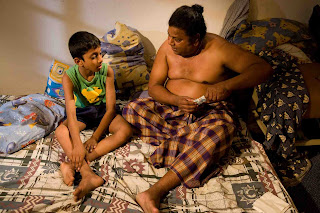

Q: Is the movie semi/autobiographical in any way?
BF: Well the story touched partly on my real life story. I have my son who is grown up now and is independent. He hates me for being a cruel father when he was young. Yes I did punish him for his wrong doing. I believe any father would have done that at that time. I also believe that no father would beat their children for no reason. He refused to accept me as the father and did not communicate with me for many years, despite the fact that many persons, including relatives calling upon him to mend the relationship. Eric knowing my life history decided to do the movie. The movie had now brought him back to communicate with me again.

Lean More about The Amazing Bosco here!

Wednesday, October 22, 2008

[TIFF 2008 Day Five]

Today also marks the start to TIFFCOM, which features the Asia-Pacific Entertainment Market.

From a film angle, after having gone around the booths, you can't help but to feel overwhelmed by the number of movies which are in various stages of production, and looking at just the Japanese output alone, I thought there were some interesting gems from amongst the noise. TIFFCOM also has its separate set of screenings, and this just adds to the array of combinations to plan your day ahead, given that you can only choose either one event from either programme to attend.

Screenings for TIFFCOM might not be in a proper theatrical hall, but at a makeshift screening room set up. However, effort can be seen in having position the screen at a correct height to prevent those behind from being blocked (non-stadium seating of course), and had a decent 5.1 sound systsem set up in the room.


There were a number of booths which I stopped over, and having no time to plough through the handouts, I'll be doing so at first opportunity when Iget home, so if I do find anything interesting from the sack of stash I have, I'll let everyone know.

Screenings today included those from the TIFFCOM lineup in Handsome Suits and Cheer Cheer Cheer! Had given up Taiwan's Winds of September to opt for Handsome Suits instead, and the other film viewed was the excellent Claustrophobia by Hong Kong's Ivy Ho in her maiden directorial debut.


I had actually planned to attend the Love Fight Arena event, given that I've been a new convert for the movie, but as the registration was cutting too close to the screening of another movie (Claustrophobia, which was fantastic), I had decided to give this event up quite reluctantly. Thank goodness for Claustrophobia being as good as I thought it would be!

This is Day 5 from the Tokyo International Film Festival, which began with a 2 hour train ride (which usually takes half that time) because of peak hour human traffic, and the inexperience of yours truly to impossibly squeeze into sardine-packed train.

[TIFFCOM 2008 Review] Cheer Cheer Cheer! (フレフレ少女)

We Did It!


Cheer Cheer Cheer! is your typical zero to hero student based movie, as the formula never ceases to churn out stories but under different student groups. My personal favourites to date have been Swing Girls and Waterboys, and although Cheer Cheer Cheer! has much of the formula applied, it still falls short of becoming great.

Momoko Momoyama (Yui Aragaki) is a romance novel buff, and one day she got hit by a baseball thrown by star player Hideki Oshima, who's also the school heartthrob. Infatuated with him, she starts to try out for the school baseball team, and the cheerleading team to cheer the baseball players on, but unfortunately just sucks at both. Undeterred, she befriends Ryutaro (Kento Nagayama) and becomes one of two members of the traditional cheer squad in the school. Mind you this is no pom-pom girls with short skirts twirling batons. I too wasn't aware that such a curricular activity exists until this movie opened my eyes to it.

It involves some really structured shouting of slogans, foot drills, drum beats and flag waving, where booming voice is required to inspire fellow cheer members, and extended members made up of the general school population. The band of five have an arsenal of cheers to choose from, which sometimes involves very specific invocation of appropriate cheers that seem to incorporate some of the unorthodox such as the powers of Heaven, Earth and Heart.

So formula dictates that both Ryutaro and Momoko have to round up the misfits and outcast and convince them of the virtues of devoting time to their cause in a recruitment drive, before realizing that they indeed are ill-prepared for the challenge ahead. At this stage you can insert as many stereotypical jokes of geeks in school being bullied by the alpha-counterparts. The makeshift team once assembled, can't cheer to save their own lives, and get external help comes in the form of alumni cheer squad members who don't want the latest edition of the cheer squad to ruin the art, and thus enlist them in a boot camp at a beach temple, much to the school children's dislike.

While there are comedic scenes to pepper the montage of training sequences, and fun analogies on tradition and rationale behind such an activity, it does get a little too repetitive, and especially struggling through since this aspect forms the bulk of the movie, before devoting approximately 30 minutes for the finale. These long training scenes sagged the middle portion, which treaded on aspects such as walking the talk, and to find true meaning in the role they are about to perform. It's the usual building of the team spirit, and you somehow just can't wait for them to graduate so that they can show off their new found confidence and skills.

The choreographed cheer of the Sakuragi school is indeed something to behold, but there seemed to be a distinct lack of fresh ideas, thus lapsing quite frequently into things we've already seen before. The individual actors' charisma also helped to ensure that one-dimensional characters are quickly addressed, and each of the actors bring something different to the table in their respective roles. Don't expect anything special to be conjured, though the trailer did make it look as if there would be some street-fighter syled special effects that will be incorporated into the fight.

If anything, this film is recommended to those who are new to the zero-to-hero genre and storyline, or those who don't mind spending time watching the tried and tested, with little adventure outside the genre's comfort zone.

[TIFF 2008 Review] Claustrophobia (親密) (World Premiere)

Take The Offer!


Written and directed by Ivy Ho, best known for her sensitive story in Comrades, Almost a Love Story, I felt that Claustrophobia showed similar expertise in its treatment of the mundane and often rote life of office workers caught up in the day to day drudgery of deadlines and uncertainties in this era of mergers and acquisitions. Lensed by cinematographer Mark Lee, this is beautifully filmed and brings out the often cramped spaces that the characters find themselves in, figuratively as well.

The film opens with a long 20 minute scene in a car as it goes around Hong Kong, where the department manager Tom (Ekin Cheng) sends his team of 4 home after a late night in the office. And it is here in this tiny space of a car cabin that you can read plenty of office colleague dynamics that any working adult would immediately identify with. Veteran Felix Lok as Karl has some of the best lines as the individual who is a “know it all” given his seniority amongst the team, and Karena Lam's Pearl often has something troubling that maintains hidden beneath her calm exterior. John (Derek Tsang) and Jewel (Chucky Woo) round up the group as the youngest, most passionate and of course, most impetuous amongst the group, being fuel for and to propagate stories from the grapevine.

Unravelling itself backwards, the narrative teases with short succinct scenes from gossips to suspicion of hanky panky, but never to show its hand fully. Rationale for such scenes, and character behaviour at current point in time do get touched upon in later parts, which is chronologically earlier. Much is still left unsaid though as the continuity in reverse order do not get embroiled in the nitty gritties, but provides the canvas and the frame on which you can draw your own conclusions from.

There are no big sequences per say, as this is a powerful conversational movie. Attention is to be paid to the candid dialogue full of genuine impact, especially when you discover hidden meanings and sarcasms when lines are read in-between. There is much identifiable dialogue for anyone who has worked a desk job before, as well as with the scenes of quirks from working in close proximity cubicles in the office. You'll probably be left in awe as if you're seeing a snapshot of an office worker's life through a two-way mirror, with knowledge of hindsight, as the movie captures the concerns of the working class in such a deceptively simple manner.

If you're led to believe that Ekin Cheng's Tom and Karena Lam's Pearl would amount to something, then you might just have to leave it to your imagination to wander a bit, since it's never explicit shown or addressed on screen. Rather, the notion of office romance with workers dating co-workers just serves as a fleeting background with both sides of the equation provided, such as how it affects workers productivity, or how it actually helps to increase morale of the person(s) involved.

Minor characters do pepper the landscape as well, in the form of Eric Tsang as Dr Chiu, whom I thought had some of the more interesting lines with Karena Lam as they share a wonderfully poignant scene with regards to love lost, and Andy Hui who guests stars as a cab driver. Well acted despite having the characters restraining themselves to knowing glances and something that is more than meets the eye, Claustrophobia would easily be amongst my favourites from the festival, and is highly recommended!

[TIFFCOM 2008 Review] Handsome Suits (ハンサム★スーツ)

Let's Handsome!


Handsome Suits might be Japan's answer to Korea's 200 Pounds Beauty, and given the success of the latter movie which deals with women's vanity in wanting to look good, this one is the equivalent, but centered on men instead, denying the focus on grooming as much as we like.

Face it, we're more than likely to turn the blind eye for someone who looks good. Maybe not necessarily drop dead gorgeous, so long as they're pleasing to the eye. The movie plays on the observation of how possessing good looks would open doors and help in getting a leg up in life, like a satire on the sad reality of life that is, but in its simplicity comes a well told story with plenty of pathos to think about, ranging from being true to oneself, and again a constant reminder not to judge a book by its cover.

Takuro Ohki (Muga Tsukaji) might be the ugliest chef around no thanks to his porky frame, but inside lies a sensitive man who stuck to a long held mantra of his late Ma's Taste at Ma's Price diner. Essentially a good man, he has no luck in love because of his lack of presentable looks, and romance is always far off in his mind. Tsukaji brings about some likability to this character, though I really must defer judgement to the ladies for frank opinions on whether they would date a guy who looks like that on first impressions, coupled with the propensity to stick his finger up his nostril (for a chef!).

Like a fantasy come true, this is pretty much done in Click fashion, with the all-powerful remote control being replaced by an all-powerful suit which looks like a cross between the Michelin Man and the stay-puff marshmallow man. Once worn and vacuumed fit, he becomes instantaneously transformed, voice included, to be as sexy as can be, with women literally swooning at his feet, and his opportunities to get in touch with the opposite sex suddenly increases manifold. As Annin Hikariyama (Shosuke Tanihara), he becomes the hottest sensation in the fashion circuit, and faster than you can say “Let's Handsome”, the coolest model in the business, Raika (Mayumi Sada) falls hard effortlessly to his charms.

It is easy to identify with Takuro's leading of a double life, one as the ugly chef, and the other as the handsome model on the brink of signing a multi-million dollar management deal. However, he's soon cradled with the mother of all dilemmas, with his ex-waitress Hiroko Hoshino (Keiko Kitagawa) rejecting both Takuro as well as Annin, which he cannot fathom why, and then his growing affection for fellow looks-challenged Motoe (Miyuki Oshima). As if leading one simple life is not enough, his honeymoon with his suit once over will bring some major headaches which he must address, sometimes with hilarious results, especially when dealing with the suit's vulnerability to hot water.

There are some opportunities for special effects, and these are done simply and to the point. What elevated this movie is its genuine comedy without trying to insult the audience's intelligence, especially when early on in the film he has to juggle with his newly established identity, lapsing constantly into his old self. Those who are keen-eyed will soon begin to see how the surprise of the movie would come as early as from the midway point. But don't go and look for such clues on purpose though, as it'll actually spoil the fun.

With a constant and not too sublime reminder on the need to appreciate the little things you do that matter, and the little joys that you can find along the way in life that is important to help keep spirits up. I particularly enjoyed that extended scene where Motoe plays a game with Takuro during their walk home, which serves as a powerful reminder to stop and smell the roses. Handsome Suits will be recommended stuff, should it make its way to Singapore. Don't leave the theatre just yet until after the end credits!

[TIFFCOM 2008 Review] Signs of Love (Ayat Ayat Cinta)

[This review is pulled forward from the archive to coincide with the film’s screening at this year’s TIFFCOM.]

Choices


Playing to full houses since the day it premiered in Singapore, Ayat-Ayat Cinta piqued my interest not only because it's a movie from the region, but also because it tackles the theme of polygamy and wears religion on its sleeve. Based on a novel by Habiburrahman El Shirazy, and it being obvious that I haven't read the book, Ayat-Ayat Cinta had a lot going for it, with its attempts at tackling various issues, but it always seemed that while it goes for the jugular, it holds back, therefore not being able to deliver its punches to the full, and strangely enough, had a scene which looked like a nationalist cry for victory.

In essence, the film splits its slightly more than 2 hours runtime into 3 acts. The first which establishes all the players, and while it seemed to dive right into the action without giving much explanation, hold your horses for their backgrounds because these will come by the time the end credits roll. The middle section might seem out of place, with its centering on a court case where you the audience is put into the shoes of knowing who's the accuser and the lies being told, but again the minutes that tick by has its importance especially when tied to religion - that God always puts forth certain trials for the faithful to overcome, in some kind of make or break scenario, to see how one stands firm and forthright in one's beliefs. And finally, the part where everyone is likely to have an interest in, but one which comes too late too soon, and the story having a cop out, is the dealing of the polygamy issue.

Fahri (Fedi Nuril) is an Indonesian religious student who's studying in a prestigious religious university in Egypt. He's the all round nice guy, who's pious as he is moderate in his values, as well as being the resident stud with whom every female he has the fortune to meet, falls head over heels with. To some of us, this seems like heaven, but seriously, it's more trouble that Fahri can ever imagine. Through him, we learn a little bit more about Islam, and his little fights against extremism, and correcting those who conveniently hide behind being deliberately out of context. Naturally this charm of sincerity and standing up for the underdog brings him admirers.

First there's fellow student Nurul (Melanie Putria), whom Fahri and his friends go to for academic assistance, because of her ties with their professor. She takes a liking of Fahri because he's probably a genius to her eyes, and being the best looking amongst the cohort of course. Then there's Noura (Zaskia Adya Mecca), a poor soul who's constanly abused in public by her father, whom Fahri takes pity and rescues. For Noura, it is obvious she's in love with her knight in shining armour, while Fahri, in his heart, sincerely just took pity on her. There's Maria (Carissa Putri) of the Christian faith, one of the first Fahri meets in his student days, and as his neighbour, they share a lot of time together in studies and play, and both find good virtues with one another, coming close to ending their search for soulmates. That is, until Fahri meets Aisyah (Rianti Rhiannon Cartwright), a German muslim with whom I think most guys would go for without a doubt - someone who shares the same religion and has deep affinity for it, a loaded family so cares for material wealth takes a backseat, and probably best of all, which I think the director Hanung Bramantyo teased on purpose, is a stunner behind that veil that she wears (you can hear gasps of exasperation when trick camera angles were used to hide her facial features).

If you were Fahri, who would you choose? In keeping to the spirit of not spoiling it for you, I shan't tell too. Of course he chooses one, based on certain criteria of his own, which doesn't surprise (hey, we're guys ok?), but the manner in which it was presented, made it seem rather shallow and superficial, whence it should be something more of a deeper connection that he should feel for his wife to be. Anyway things are never rosy with a marriage, and soon enough, melodrama dictates that his marriage will be on the rocks since husband and wife hardly know each other - with a matchmade like ritual being the bridge between two hearts - and a more severe trial being put in their way, which calls for the courts to be involved.

As mentioned, Ayat-Ayat Cinta never fail in finding opportunity to talk about religion, and in fact I enjoyed such moments as its principles can be applied regardless of your own personal beliefs, as they are universal and would be in agreement with any reasonable person. And it brings to mind certain things we do too, such as the doubts that creep into the minds of even the most pious, when it seemed that the almighty had somewhat forsaken us when we are stuck in a rut that we believe couldn't happen to us since we should be in God's good books constantly for putting his sayings into practice. But I guess the old man above has his own sense of humour and share of wanting to shake things up a little to separate those who pay lip service only, from those who are truly sincere.

Given that the story's central theme is on love, you don't really get much of that until the last act which lasts not more than 20 minutes on screen. Touching on love and sacrifice, you'd wonder how those who have polygamous relationships handle the requirements of it all, and the superb time management which they supposedly possess. Juggling multiple girlfriends or dates is a piece of cake, although sometimes there's always that very few close shaves. Juggling more than one wife under the same roof, calls for some serious soul searching, and the obvious courting of trouble with a capital T. While there are those with virtues like patience, tolerance and the likes, I doubt many women out there would willingly (and this is the keyword) share their husbands with another woman. Here, it's out of circumstance to save his own rear, at least how it was played out, despite obvious clues that it wasn't, and it again serves as a reminder to think through this vowed devotion very thoroughly, before taking the plunge. It boils down to being fair, being honest and being sincere, versus what you think might be pleasing in the eyes of a deity. Again without spoiling it, you do feel for the character who has to make this call and sacrifice. Love hurts, doesn't it from time to time?

Ayat-Ayat Cinta in its separate acts, have moments which stand out and fulfill their purpose, but when strung together, you'd feel that there are plenty more it could have addressed without relegating some issues to the backseat, and of course some minor elements which could've been dropped. I guess like the relationships in the movie, it had to pick and choose its battles, and what was delivered was still engaging enough to sit through.

[TIFF 2008 In Memory Of] Jun Ichikawa

The first time I encountered Jun Ichikawa in person was during last year's Japan Film Festival in Singapore held at the National Museum, where he was the festival's Director-in-Attendance, having a showcase of his movies presented, which included his latest movie at the time, How to Become Myself, and to conduct a Masterclass Lecture for a 250 strong audience.

I do recall fondly when the Masterclass Lecture was over, a group of fans went up to him for photo opportunities and to request autographs. I was close enough to hear him comment, being quite amused at the enthusiastic response from the audience who stayed behind, that he felt like a rock star. He did pose gamely with his fans, and responded to some personal questions outside of the session, and signed off a couple of autographs too. He came across as very affable and without airs, and that left a deep impression on me.

I was shocked then saddened to learn of his passing away last month. I had looked forward to meeting him in person again during this year's Tokyo International Film Festival as he would have presented his latest movie buy a suit.

In remembrance of the great director, here's something from my archives to share with you, which is an excerpt of his Masterclass session held in Singapore almost a year ago. It's a pity that we won't get to see his intention of making a film about the elderly, come to fruition, something that he made mention about then.

LtoR: Leong Chun Meng (Singapore Film Society), Jun Ichikawa and Interpreter


The following panel discussion was done through an interpreter, as Jun Ichikawa felt more comfortable conversing in his native tongue. So I suppose some bits might have been lost in translation as I can't understand Japanese too. But nonetheless, to the best of my ability, here it is:

Q: Could you tell us more about the writer of the story How to Become Myself (Kaori Mado), and the inspiration for the movie?
Jun Ichikawa (JI): First of all, the author of the story (Kaori Mado) is a lady about 30 years old now. She's now a staff of an advertising agency for mobile service provider NTT Docomo, one of Japan's largest. The author is brought up in a girl's only school from junior to senior high, and the book is something like her autobiography. I read the book and I loved it, especially the themes of the "fake" and "real" me. Each time I think about the "fake" me, I think about the author.

When we talk about Dazai Osamu, his works contain issues about the "real" and "fake" me. Everyeon when in their youths will face this issue, so I thought that it's good Dazai appears in the movie, so it's inside.

(Ed: I obviously haven't read the books by Dazai, but I think this one could be the reference point of this read/fake me issue, about the character having an incapability of revealing himself to others and is forced to uphold a facade.)

Q: Was the movie adapted from a short story?
JI: It's about 200 pages.

Q: The actress playing Juri (Riko Narumi) had a subtle way of showing emotion. Was it difficult to get her to show her emotions?
JI: On the contrary I felt that she expressed a lot of emotions! She's a child actress who had started acting at age 5, and she's a very good actress. She became popular from a television series, and acting for television is easier. But for the movie, I've been telling her not to express herself so much! She's 14 now, and in my opinion, a child prodigy in acting.


Q: In your previous movies, there are a number of female characters in their youths. Are you interested in this kind of stories, or have any message to convey to this particular group?
JI: If I use a young actress, it's easier to get the budget (laughs) and to convince the producer. When I look at my filmography, you might misconstrue it as I'm liking little girls but I'm not! I believe that inside everyone's heart there's a little girl, and good writers have this young girl inside them.

Q: Why do you like to express the common theme of loneliness in your films?
JI: When you're watching a movie in a darkened theatre, you are alone. Watching a movie on a DVD doesn't count. When I study good American movies, there's a theme of loneliness in them too. Stories which usually have a main character who's lonely, and then there's a breakthrough, resulting in a changed person. Loneliness is a condition to have a good movie. I watched a lot of 70s American movies like Taxi Driver, and I was influenced by those movies made after the Vietnam War, which has a lot to do on loneliness inside. When I was young I watched a lot of these movies.


Q: You have featured Tokyo in many of your movies, and sometimes successfully made metropolitan Tokyo seem like a small town. What kind of Tokyo would you like to present to moviegoers?
JI: I think I share something similar to Woody Allen. Woody Allen was born and brought up in New York. In a big city, there's a lot of people, and in a crowd you'll sometimes feel alone. I thought movie directors brought up in big cities share a similar sense as what I have felt.

Q: Every director brings personal experience into the film he directs. Does your own experience help in your movies?
JI: I'm 60 years old, and have already gone through many sorts of lives in my own, and those represented in books and movies. When it comes to this movie, I tried my best to understand the feelings of the author of the novel, and think about the big issue now in Japan, which is bullies. I was thinking about the issue in the context of my young grandchild.

There was a question about the camera techniques used in Tony Takitani, and the panel in panel shots for How to Become Myself.
JI: In Tony Takitani I was thinking about flipping a page from left to right as if I was reading the novel. As for today's movie, the panels are in one screen showing the different things different people are doing at the same time. We can see many things happen at the same time on one screen, which you cannot do so in real life. With digital processing this becomes easy, and it's actually not considered a high tech method. I do not think I'm giving the impression that I'm doing something high tech.
Comment: This technique might be appropriate here since you're showing both the "real" me and the "fake" me together...
JI: When I watch MTV, they're doing the same thing (laughs)

Q: I noticed in Tokyo Marigold, Tony Takitani and now How to Become Myself, are you also exploring the identity crisis of modern people?
JI: I don't think much about identity crisis.


Q: With the "real" and "fake" me personae in today's movie, Eriko from Tokyo Marigold and her real and commercial self, in Death in the Hospital the shots of the hospital and the real world, in Tony Takitani you have 4 characters played by 2 persons, what is the message you want to send to the audience about this real and "virtual real" worlds?
JI: I like something that comes with realism. I'm having a hard time trying to understand the question (laughs). I don't think it is useful to analyze my works, as I think movies is something you just enjoy. Sometimes movie critics analyze my movies in ways I've never expected. For me, I make movies as I like and as I want, straightforwardly according to my feelings.

Q: Did you always know you wanted to go into film?
JI: I was doing oil painting as I wanted to study in the National Art University. I drew a lot and tried to enrol but failed each time. A friend discovered that I can draw good storyboards for commercials, and I joined a commercial production company, which started to employ me to make commercials. The commercials I made were well accepted by the public, and one day someone came and approach me to make movies. So in a sense I was fortunate.

Q: How did your commercial experience influence your filmmaking?
JI: It's a negative influence (laughs)! For example, the cut is too short, and I have the habit of expressing more superficially than going deep. If you had watched my debut movie, you'll be shocked! The cuts are short and fast, and there's no room for you to breathe breathe or relax.


Q: Any advice for making a first film? Does it have to start with scriptwriting, or doing commercials first?
JI: You can start tomrrow, and use your own camera. The issue is what you want to express. You can take many years. The most important thing is to think what you want to express. And to everybody, the first debut product is important.

Q: Are you doing any films now, and what is it about?
JI: It is still under planning, so I can't announce it yet. If you've seen Wild Strawberries by the late Ingmar Bergman about the elderly, then yes I would like to do something like that. I'm tired with girls movies (laughs).

Q: Do you like to keep your movies slow?
JI: I think I'm trying to let go of my habit from commercials, with the fast cuts. So my movies tend to have longer cuts and slower shots. Sometimes 15 minutes into the start of my movie when I'm watching it in a cinema, I can hear snores (laughs), but I let it be as I can't do anything about it.

Ichikawa-san also mentioned that during editing process, he tends to think about "self", so perhaps the theme of loneliness tend to creep in as you're alone in that process.

Q: What's the state of the Japanese movie industry today compared to the 60s and 70s?
JI: It's terrible. The movie production companies don't have enough human resource. For example, Akira Kurosawa was with Toho, and Ozu was with Shochiku Kinema. There's no such arrangements now. All of us are free and don't belong to companies. We are daily hired, which also means "daily-fired". Even producers are finding it a hard time to find jobs. We also have to struggle with low budget when trying to make good movies.


Q: Having worked with so many actresses, which one do you consider the best to work with, and is there anyone else you would like to work with?
JI: I think it'll be kind of rude to rank them in that sense, so I won't do that.
Q: Then which one left the deepest impression?
Ichikawa: Perhaps Riko Narumi in this movie. I didn't know of her as I don't watch much television, and someone introduced her to me. Now I think I have to do more auditions, and meet more actresses.

Q: In real life it may not be easy for young people to change their lives around. Did you have the intention to make the movie tinge with some sadness and uncertainty?
JI: In the original story, one interesting thing was the words "Happy End" appearing in it. When you look at Japan society now, it's hard to find "Happy End" and what exactly it is. I think it's about the wish you want to get, and this feeling that makes the movie interesting. Mobile phones are featured quite a lot in the movie, but I didn't want to make it "in" and "trendy".

Q: What are the influences Ozu has on your films?
JI: It's no point trying to copy his methods. But I want to learn from him the spirit of a movie director - protect what we believe, and to stick to what we want to speak about. Ozu is the director that I love the most.

Tuesday, October 21, 2008

[TIFF 2008 Day Four]

The festival continues to leave solid impressions on how well run it is, and its pulling off all stops to ensure that the public too can enjoy and partake in the festivities this week.

But first, I had a little luck with the public screening tickets too, given that I had to be turned away empty handed for The Shonen Merikensack, a movie that I had wanted to watch when I first earmarked a selection of must-watch from the festival lineup. So probably as a form of compensation, I managed to get tickets for today's public screening of Taiwanese movie Beautiful Crazy, and by the time the movie was screened, it was already a full house. I didn't really enjoy it that much (you can refer too my review) though.


It's also my first live event coverage after the Opening Ceremony on Saturday. Not knowing what to expect because this was only confirmed last night / earlier today, I thought this event was one of the most fun, since it had mostly a public audience in attendance out in the open, and the cast came in full costumes per their roles in The Cherry Orchard – Blossoming. It was done talk show based, and the unexpected confetti at the finale was something of a crowd pleaser. When the sun set over Roppongi Hills, the entire Arena area was decked in the pink colors of the Sakura.


After spending the last couple of screenings at the first level of the Toho cinemas at Roppongi Hill, I finally get to move up to the larger halls since it's a public screening (of aforementioned Beautiful Crazy), and the ads that play before the movie begins are hilarious. During the Q&A session after the movie, no less than 3 interpreters were on hand to facilitate and translate the proceedings, switching between English, Mandarin (since it's a Taiwanese film), and Japanese effortlessly. I guess the army of volunteers extend to the translating team as well, given that one of them is dedicated to translate for the guests who were not directly asked any questions, so that they can understand what's going on, rather than to just sit and smile.


And if I'm correct, film fans who want to catch a glimpse of their favourite cast, crew and stars could do so after every Teach In Session, where they would be at the foyer of the cinema gamely posing for photos and signing autographs on anything such as tickets, programme booklets, posters and even postcards. I guess in those precious few minutes, it would provide some means to connect with their fans, and naturally, it goes without saying who would have added skip in their steps when they make their way home after the screening.

The Press Center was full today, or at least during the times when I popped in, and overheard something that was food for thought – does reviewing ony good movies, elevate one's status to premium level? Then again, isn't “good” movies strictly speaking, subjective?

This is Day Four from the Tokyo International Film Festival, which began with a 3 hour very early morning round trip to Tsukiji Fish Market for a sushi breakfast at Sushi Dai!

[TIFF 2008 Teach In] Beautiful Crazy (乱青春)

Left to Right: Liao Chien-hui, (translator), Angel Yao, Lee Chi Yuarn, (translator/moderator)

Director Lee Chi Yuarn and actresses Angel Yao and Liao Chien-hui were in attendance today for the Teach-In session after the screening, and the following is an excerpt of the discussioin:

Q: Why are three different colours and styles used in the film – full colour, strained and monochrome?
Lee Chi Yuarn (LCY): The themes of the film is on time, memory and love. Memories never stop flowing, and for this aspect, the cinematographer has opted for a handheld camera to demonstrate the fluidity of memory. I avoided the traditional way of using flashbacks, and rather, I used flash forwards. I want the audience to enjoy the feelings portrayed in the movie, and not to follow the logic. I'd rather they experience what the characters experience, and to sit back and relax, to follow their feelings and see if they feel touched through something similar experienced. Black and white is not necessary in the past, but can mean different things.

The director also shared that despite not knowing the language, his Dutch cinematographer was also moved to tears in one particular scene involving the father and daughter eating ice-cream at the shop.

Q: I notice that the film has many long takes and long dialogue, was it challenging to do film in that manner?


Angel Yao (AY): I was lucky to have little dialogue for my role. Even though the scenes were long takes, the director allowed us to be free and not rigid with the lines, and for us to react to what happened there and then, so it was a rather enjoyable shooting process.
Liao Chien-hui (LCH): The long takes allowed emotion to flow more naturally, and not feel as if we needed to cut our feelings halfway. The difficulty I had faced was in my memorizing the dialogue for my confession scene. For that scene, I was not allowed to chnge the dialogue, and it contained a number of vulgar words that I did not use.

Q: The movie starts with short scenes, then they became longer in length which became self-explanatory. Could you explain this further?
LCY: I didn't use a conventional script, and had used cards to write down scenes and improvised from there. You can say that the film was “edited” rather than scripted. I took 7 days to write it, 18 days to shoot, and spent a year to edit the film.


Q: What kind of actress would you hope to be in the future?
AY: I was a child actress doing television commercials, music videos and so on. I know I had wanted to become either an actresss, a singer or a dance instructor. When I got a call from the director, he had offered me the role of Angel. After making the film and having it screened to an audience, I'm happy with it, and thought that I've done a good job and made a good decision. So I want to become a film actress rather than an actress in one of those Taiwanese idol serials.
LCY: This is my first movie, as I was studying film production back in the university. After making this movie, I am inspired to want to pursue a career in acting in film, even witth directors worldwide. I'm happy to be able to participate in the Tokyo International Film Festival this year!

[TIFF 2008 Review] Beautiful Crazy (乱青春) (International Premiere)

Carefree


For a festival of this magnitude, if you find joy in almost every film watched, then you must be really lucky. It's always a hit and miss for me, and unfortunately, Beautiful Crazy fell into the latter category, despite its modest budget looking glorious on screen, and I still have to accept the fact that not all films have to come with a structured narrative, as this one seemed akin to flipping through a photo album of fleeting images on screen, with neither room nor clues to apply some logic to stitch the disparate scenes together, presented in a non-linear timeline.

“Beautiful Crazy” might not automatically cue you in as to what to expect from the movie though it might be apt to describe the state of mind of its 3 female protagonists Angel (Angel Yao), Xiao-Bu (Amiya Lee) and Amy (Liao Chien-hui), but its Chinese title literally translates into “Messy Youth”, which provides a far better expectation. Indeed the youths featured in this movie are really quite messed up, each having their own personal problems which they are unable to solve on their own, or be able to obtain proper advise on how to deal with them. They live quite a decadent lifestyle free from the pressures of the school system, and spend time frolicking in beds of sunflowers, or dancing away in abandoned ruins.

The camera definitely loves these girls, from the way it lingers along their limbs, incorporating some dream like movement in its photography frequently set against a gritty environment and backdrop. And that's the strong point in the movie, with its cinematography in stark black and white, full coloured, or strained, and looking very beautiful. But this technique was chosen as a means to distinguish between the passage of time, and here's where the crazy part comes in, as it goes back and forth without much warning, sometimes for scenes lasting just a few seconds, while others some considerable dragged out minutes, such as a blow by blow oral account (for the lack of a better phrase) where one kiss-and-tells the other of her virgin sexual encounter.

Repetition also get used very liberally, and it hammers home some deja-vu moments, while expanding on some others which provide a little more suggestion in peek-a-boo fashion as to what the scene is about. As advised by director Lee Chi Yuarn, this is a movie about feelings, rather than logic, but the only vibes I'm getting from the movie was a sense of frustration, and disconnect, looking at the way Beautiful Crazy was presented.

There's nothing much to show for in its convoluted story, if one exists at all, as it has little snippets of small plots such as their relationships with their fathers, romantic relationships where one of them sleeps with the other's boyfriend, and also a hint of pseudo-lesbianism which could probably provide this film some legs in the GLBT festivals.

[TIFF 2008 Arena Event] The Cherry Orchard - Blossoming Talk Show


TIFF continues with its big scale presentations for the general public with the scheduled appearance of the cast from The Cherry Orchard – Blossoming. When the sun set over Roppongi Hills, the entire Arena area was decked in the pink colors of the Sakura, where the cast made their grand entrance to the venue by virtue of a mini school bus, keeping in line with the movie's school setting.


The crowd went wild as the fans recognize their idols emerging into full view, before being ushered onto the stage to partake in a hosted game cum talk show, before a burst of confetti brought the proceedings to a close, and they had to make their way to the cinema hall for the scheduled Greetings from the Stage for those who had bought tickets for the movie's screening this evening.

Conducted in Japanese (of course), here are some videos from the event:


And photos from the event presented in a slideshow:

[TIFF 2008 Review] Love Fight (ラブファイト)

Wimp!


Love Fight steers itself into familiar romantic comedy territory, but has enough pathos to make it one engaging drama about first loves, denial, and of course, boxing. But this is no Million Dollar Baby despite some minor similarities in characters and set up, being far from it with its relatively fluffy take on boxing, and without any major weepie moments. The pairing of both Kento Hayashi and Kie Kitano seems to be perfect as the proteges of a one time boxing champion, one being offensive, with the other being defensive in nature.

Minoru Tachibana (Kento Hayashi) is a wimp, never dare raising a hand at anyone. Timid, meek and good natured,, thus being a constant bully fodder. Things don't get any easier for him when childhood friend Aki Nishimura (Kie Kitano) grows into a beautiful lass, and boys who want to get to know her, bullies Minoru into setting up dates, or if misunderstood, they just want to take potential rivals like himself out of the equation. In comes Aki to save the day, as she has an angelic face with deadly skills (watch out for those roundhouse kicks!), or as put, a ferocious beast hidden under the pure facade. She deftly deals with all of Minoru's bullies, and it becomes a wash-rinse-repeat cycle that Minoru could endure no longer, one which requires constant protection from a girl.

The narrative shifts over the course of this movie, being somewhat like a jack of all trades, going from subplot to subplot with much needed depth, but at times isolating all the other narrative threads totally, that it could have felt it was 2 movies put together. However, as a whole it is still thoroughly engaging and well paced, and I found myself lapping it all up.

Set in Osaka, the 2 major threads see the love-hate relationship between Aki and Minoru, as they blow hot and cold (usually), while you just wonder how long it will take before they start to realize how perfect they are for each other. But of course in comes Kyoko Okuda who takes a liking for Minoru, and what I thought would be fantastic (but wasn't exploited) was how Kyoko's research into Aki's weaknesses could have provided some added advantage, and especially dangerous should the information fall into the wrong hands. The other thread belongs to Takao Osawa as Joe Ohki, a one time national boxing champion who has fallen into hard times because of losing the love of his life, Junko Misuki, now a minor actress. It chronicles how two has-beens and old flames have been trying to reconnect with each other. This runs in parallel to the romantic story of the younger generation, and put side by side, makes for excellent contrast.

And of course the fun factor here is the boxing scenes, where you get the usual training montage of all the students under training in Ohki Boxing Gym under the management of Joe and his chief trainer Mr Takae. Especially funny is how the wimpy Minoru starts off his toughening regime, while Aki provides her own brand of comical relief in the way Joe tries to harness her raw power and energy into a disciplined manner, since she's constantly left exposed by her aggression and without defensive skills, leaving her quite vulnerable.

There are some really poignant moments as well that might tug at your heartstrings, with its standard melodramatic offering in having the master, for the love of his gym and the aspirations of his two fledging students, decide to make some compromises with his values. And what I found to be totally strange, is how the character of Kyoko gets completely forgotten midway in the movie, only to resurface with a revelation that I thought could be properly handled or build up on, rather than to have a sleight of hand change.

Despite its really minor flaws, this is certain to be a definite crowd pleaser especially with the star power of Kento Hayashi and Kie Kitano, touted as the Gen-Next in Japanese Cinema. It has comedy, a simple to follow story, well-acted roles and as a feel-good movie, it just doesn't get any better than what this movie has to offer. One of my personal favourites in the festival to date.

[TIFF 2008 Review] The Cherry Orchard - Blossoming (櫻の園 -さくらのその-) (World Premiere)

School Sisters


Back in 1990, Shun Nakahara made Sakura No Sono, a movie which is set in an all girls school, where as part of the school's anniversary, the students will get together to stage Anton Chekov's “The Cherry Orchard” play. That story had the group of students taking on different gender roles in the play, but may face cancellation because one of their students was caught smoking. Updated for the current generation, because smoking is no longer a shocking phenomenon amongst girls, so we have, as a dampening reason why “The Cherry Orchard” couldn't be staged, the rationale got refreshed involving unwanted pregnancy and suicide.

But it's not a direct remake because there were obvious changes to names, characters and premise. I would have thought that it could have been to introduce the ensemble cast of actresses collectively to a whole new generation of audience, home and abroad, and if so, then this would have been something similar to television drama serials with updates of such nature to cash in on popularity stakes. I suppose roles like this provide a platform to introduce a whole new lineup of potential stars in one fell swoop, such as Saki Fukuda, Saki Terashima, Anne, Yuko Oshima, and Haneyuri.

Saki Fukuda takes the lead role as Momo Yuki whom the story revolves around. We see how her maverick streak has her do things her own way, and the introduction to her character giving up her violin demonstrates just that. Transferring to a new elite school for girls, Ohka High, the traditions and steep culture seem strange to her (even to me too, such as bidding hello and goodbye to the school structure!), but worse, she comes with pedigree that her mother and sister are prominent alumni of the school, and thus would probably face some pressure to perform.

As the rebel in a school of conformers, she ventures defiantly into an old dilapidated building within the school compound, and finds a manuscript for a play called The Cherry Orchard. But alas she and her group of friends are forbidden to stage it because of some skeletons in the school's closet involving a scandal which tainted their image.

The story seemed to have also adopted the zero to hero formula at first glance, since it had its lead character being clueless about the craft required (in this case, directing a stage play), having to do recruitment and casting amongst her group of friends, trying to motivate them into thinking and performing collectively as one unit, versus dealing with the different expectations of experience gained by each of her cast and crew, and the list goes on, right up to a training montage sequence and the finale where one would have expected some form of big-bang performance. However, it wasn't possible because this meant another movie altogether, but you get my drift.

The adversary that they faced was more dramatic though, being threatened by expulsion by the school administration of not only herself but that of her schoolmates as well should Momo decide to forge ahead with plans to stage the play in any form and even at an external venue, but in comes some form of examination into redemption for an earlier lost generation being robbed of a chance for an unforgettable teaming of skills.

There were a couple of subplots thrown in that just took up screen time and were quite unnecessary, such as a useless romantic subplot for Momo with Shu her busker friend, and the proposition to join his band as they are going to perform big time in Tokyo. The finale also seemed a little too hurried and a tad convenient as well with all the cards falling in the right places, and a terribly quick realization of a lesbian's dreams, which I thought could have been more deftly and subtly handled from the onset given more screen time for it to develop, as this theme seemed to have been carried over from the earlier movie as well.

All in all, this is a movie that doesn't try to attempt a lot more than it could chew, and seemingly satisfied to just coast along from start to end without wanting to complicate matters. Easily an accessible chick flick that has elements to would make it reasonably popular because of the casting.

[TIFF 2008 Review] 1408

[This review is pulled forward from the archive to coincide with the film’s screening at this year’s TIFF.]

Do I Look Like a Sucker?

If you believe in urban legends, there are some pretty nifty ones out there regarding hotel rooms. You know, the ones about not requesting for a room with a double bed when you're alone, or to check under the bed, cupboards for erm, extras, or the golden rule to knock before entering. Pah! you may say, but some deem them standard operating procedures as you just do not know the history behind the strange room you're going to spend the night in.

Based on a short story by horror maestro Stephen King, 1408 is a horror tale about an evil hotel room. It's so evil, that the entire movie for the most parts is devoted in that single room itself. You can say that the room is the star of the movie, but I'd rather give that kudos to one of my favourite character actors, John Cusack. Cusack plays writer Mike Enslin, whose popular works include his accounts in checking out supposedly haunted hotel rooms, with scientific equipment in tow and a cynical mind, to live and tell the story. He's a non-believer, but in order to get that regular paycheck, he writes what his audience wants to read.

Until he got an anonymous invitation to visit the Dolphin Hotel's room 1408, whose notorious history has a series of bizarre murders taking place within the confines of the room. Picking up the challenge much against the wishes of hotel manager Gerald Olin (Samuel L. Jackson), here's when things start to really go bump in the night. Touted as the room where you won't last an hour in, we follow Mike Enslin as he tries to uncover just what is the mystery behind this evil force is, but like the cynic in him, we start to cast that suspecting eye on Mike himself - is he going insane, letting his dark history catch up with him, or is the room truly hell in luxurious settings? It's basically Jumanji within four walls, as wave after wave of spooky events hit Mike, and tests the limits of his sanity.

And there are some genuinely spooky moments in 1408, so credit goes to the filmmaking team in setting everything up for little climaxes in the narrative. But too much of a good thing tends to make it seem like being stuck in a repetitive loop, and before long, you'll be crying out loud for the entire episode to end, just like how Mike just wants to get out. For a small set, 1408 unleashed total mayhem onto itself, so much so that you suspect it doesn't know how to end, falling prey to the multiple ending syndrome, and at one point I was cringing that it could go along the same direction as that Nicolas Cage stinker Next. Thankfully, it didn't, but it after too much ingredients stuffed into it, the outcome was really quite bland, that its ending, with great promise, just doesn't wow, after the fatigued long drawn route to conclusion.

In actuality, what made this movie engaging is that John Cusack essentially does a one man show here. Fear, despair, desperation, hope, we see it all as his Mike battles with the unknown with great aplomb. He doesn't disappoint, and one of the highlights is his sparring with Samuel L Jackson as the hotel manager with an attitude. But don't hold your breaths for many scenes where they appear together. Despite having shared top billing with Cusack, Jackson got nothing more than a supporting role here, showing shades of his mo-fo attitude, before having the spotlight centered firmly on Cusack again.

Great buildup, effective spooky moments, but overall a rather dull affair if you piece them all together. And one thing's for sure, you'll never listen to The Carpenter's "We've Only Just Begun", in the same light ever again.

[TIFF 2008 Review] An Inconvenient Truth

[This review is pulled forward from the archive to coincide with the film’s screening at this year’s TIFF.]

Heal The World

"You can't make somebody understand something if their salary depends upon them not understanding it." - Upton Sinclair

Now if there's a story that's terrifying, An Inconvenient Truth is more horrifying that the recent slew of horror and disaster films out there, because, if you buy the message, this is true, and what's happening right here right now. We can't escape the consequences if we continue doing what we do to harm Nature, but yet we still have the power and ability to make a difference.

Sounds simplistic? Well, maybe. Then again, cynicism will not help any bit. An Inconvenient Truth is a documentary, touching on the very issues of our survival and existence on this only planet we call Earth, the only one we can call home. Al Gore, used to be the next president of the United States, or could be if going by popular vote, brings to us, on the big screen with the assistance of director Davis Guggenheim, an issue he holds dearly, as seen in his relentless crusade around the world, to spread the message that the Earth is sending out SOSes, and we need to respond.

The issue of global warming, and the cranky weather and natural disasters we are facing of late, is nothing new. But perhaps, in about 100 minutes, here is something, a presentation that hits home, that summarizes succinctly all the cause and effects, the whys and the how tos. Filled with charts, facts and figures, and lively animation, these are but some of the techniques Gore uses in his slideshow presentation to ring home the message. In fact, I would say it's an excellent package put together for presentation, and anyone could take away a tip or two, on effective public speaking.

To some, the documentary is a no-brainer to put together, as most of it focuses on Gore delivering his message, as if you were there listening to him from the stage floor. True, the setup might not be impressive, but the message is too engaging for you to realize that it might be a little bit lazy in the filmmaking aspects. Having said that, it's precisely jazzier styles were not adopted to keep the attention on the message instead.

And keep to the message it does, with just little time on the outside of what Gore does on his travels, some little glimpses into his family life, life before, during and after the close-call year 2000 presidential elections. You do wonder though, about the what-ifs, should he had won the elections, and what difference he would have made on these issues when in the White House.

It is clear that modern civilization has an increasing negative impact on the environment, and with the mega developing countries seeking its path to economic equity, one would only shudder at how much more damage could be done, and the devastating after effects. Politics usually steer clear of issues like these, and instead, picks and chooses battles with a higher confidence of success. It's sad, but true.

The funniest part about this, and I'd bet during any screening, is whether anyone will buy into what was being delivered. There are tips handed out during the end credits, on how individuals like you and me could help do our part to save the environment. They aren't huge projects, but very simple ones. And no prizes for guessing there are many uninterested, heading straight for the door when the credits start to roll.

"It ain't what you don't know that gets you into trouble. It's what you know for sure that just ain't so." - Mark Twain

Watch this, and let's do our part!

Visit the official website at http://www.climatecrisis.net for more information.

Monday, October 20, 2008

[TIFF 2008 Day Three]

It's Day Three of the Festival, Today's events at TIFF was a relatively light one, having scheduled only 2 screenings today, one being Pang Ho-cheung's Trivial Matters (I would try hard not to pass up watching a Hong Kong movie in glorious Cantonese language) and The Code, a Japanese movie about codebreakers, which I found out was just a teaser for the actual story that didn't have much to do about that subject after the first engaging 10 minutes.

As I had signed up for an Imperial Palace tour beforehand, I didn't feel that it was right to cancel it at the last minute, even though I could. So it was perhaps also a good break from the schedule of weekend events, for some time off from the movies to rest and relax a little, before the next burst of energy for the upcoming week.

While I was lauding the precision and punctuality of the Japanese, I got a little worried when I was running late for the tour I signed up for. From deciding to switch train lines rather than stick to the current one which might take longer considering the number of stops it made, as a rookie I was in for a surprise because although the train lines might stop at the same station, they could be as far as half a kilometre apart! So what turned out to be time saving from reduced number of stops, turned out to be quite the nightmare to trek from one train line to the next.


That said, the last leg was on a train line that didn't have any trains call on the platform. Being one station away and in a rush for time, the decision was to walk the rest of the way, and as it turned out, while I was indeed late for the tour, to my surprise it hasn't really started, so I didn't miss anything. When I went back to the same station after the tour, it was discovered that there was an earlier incident at one of the train stations along the line that had temporarily disrupted service.


My discoveries for the day continued when I popped into the Press Center, this time with my eyes wide opened, and remembering that hey, the members of the press will be taken care of, and beverages provided at no charge, courtesy of one of the sponsors Coca-Cola. At least now I can lighten my load and need not lug around a bottle of water, or to hunt for drinks along convenience stores en route to Roppongi Hills, or stop by vending machines, not that they're difficult to find one in Japan. This is Day Three, from the Tokyo International Film Festival.

[TIFF 2008 Review] The Code (暗号) (World Premiere)

The Code's 507


The Code has an excellent premise which succinctly introduced the fictional espionage world in which the Detective Office 5 operates in the city of Kawasaki. Like an MI6 or CIA equivalent, their agents and operatives go without names, and are referred to by 3 digit numbers starting with 5, and distinct uniforms of black suits and bowler hats. Could have been a classic in the making, if not for the overwrought plot weighed down by plenty of confused, emotional baggage between its characters.

The movie begins a few years ago, and at a frenetic pace gripped by unknown terrorist bomb threats throughout the city. The challenge for the authorities is to defuse all the bombs or suffer unrepairable damage to lives and property, and the bombs could be stopped if the codes attached to them are deciphered. We're then introduced to the Information Science Lab within Detective Office 5, and it elevates mathematics geeks to god-like status with sole reliance on their keen abilities. Credit must be given to director Kaizo Hayashi and the visual effects team for jazzing up this segment to entertain, and not let the audience be underwhelmed by plain numbers and mathematical theorems.

The gem in the organization is 507 (Kikunosuke Onoe), a code breaker extraordinaire with skills par none, but like all knights with chinks in his armour, his detective skills are found to be wanting, and in his latest requested mission to go to Shanghai to crack a mysterious code tattooed onto the body of a cabaret singer Meilan, his lack of keen instincts for danger make him quite vulnerable, if not for a card like gadget that would make James Bond's Q very proud.

Being set in the Chinese city of Shanghai, there were some painful spoken dialogue in Mandarin, though you have to admire the actors' tenacity to get their diction as correct as possible. Villains too were rather cardboard (Chinese Triad) with plenty of goons and over the top characters who tend to overact. Villains also tend to lapse into unnecessary soliloquys which extend the unnecessary overlong last act, which doesn't seem to want to end with characters refusing to die off cleanly.

Bloated by subplots such as an unnecessary and cardboard romance, 507 actually disappears most of the time and the story shifted focus to the vendetta of a mysterious sharpshooter Mr Shiina, and his once colleague and now Chairman of Detective Office 5, Sonny, as if to contain a separate movie by itself in its back story about the two (now old) men, their invincibility, longevity and marksmanship which is inspired by the Wild West, cowboy hats, six shooters and all. Attention is also closely required to track all the revelations in relationships, shifting loyalties, double and triple crossing amongst all the characters involved.

Like the movie warned in the beginning, there is no clear cut heroic figure in the story as the Detective Office 5 has no mavericks, and this remains true. However, I suppose if response to his film is good, there would always be room for sequels, and staying true to mantra, there are more than enough characters to be created out of the remaining 5-hundred numbers. An excellent start for the first 10 minutes, before the pace slows considerably. Those expecting much code-breaking action given the title will be disappointed to find out that there's not much of such situations for the hero to exercise his abilities, which is a pity.

[TIFF 2008 Review] Trivial Matters (破事兒)

Spread Eagle


After watching Pang Ho-cheung's Trivial Matters, the stark reminders I have been keeping in view have now gone into red alert, that I've been missing plenty from this Hong Kong director, and I should really take some time off to plough through his filmography to date. Containing a series of 7 shorts that cover a spectrum of genres dealing with love, sex and death, one could only imagine the number of entertaining stories that are brewing within Pang's head, being a writer-director to look out for, as well as his clout in rounding up plenty of stars to take up roles in this collection of shorts.

Perhaps too I was naïve to think that both Edison Chen and Gillian Chung would be sharing the same screen pre-scandal days, as they have roles in different shorts instead. Civisim is the shortest of the stories here, and I thought he might as well be playing himself, speaking in English and trying to impress a beautiful girl in a disco about his active role in civic responsibility, which I'm sure some of us guys would probably partake in (which involves pee and manure), but to brag about it, who knows?

Chapman To, who also serves as producer for this movie, plays a character mimicking himself when talking to Eason Chan for a role in what would be It's a Festival Today. But in the short Recharge, Pang again weaves a sensitive tale for Chapman's character, about a man who shares a moment of compassion with a prostitute, despite what would prove to be a scare at first, and whether it's possible to be disconnected between sex and genuine concern for a fellow human being. Simple and sweet, somehow.

Eason stars in one of the two longest shorts in the film. In It's a Festival Today, his Fu has started a one-month long relationship with Wai Ying (Chan Yat Ning) and they have begun to cohabit. But Wai Ying refuses to get intimate with Fu, making him miserable and constantly pining like a puppy dog to want to get it on with his girl. It's an outright comedy thanks to Eason's hilarious take as a desperado, in how he finally convinced and cultivates Wai Ying's agreement to provide oral sex, but the payload (pardon the pun) comes toward the end with a very stark but effective change in genre from comedy. Definitely one of my favourites, and I thought Eason was probably having a field day with this role, going from constant frustration to finding bliss.

The other longer short was Ah Wai the Big Head staring Gillian Chung as the titular character, and Stephy Tang as Kate, two friends from schooldays, with the former treating the latter as her best friend, but with the latter thinking that Ah Wai is an emotional leech, and often dispenses any advice that would get her off her back. Encouraging her to go for Eagle (Juno Mak), a tattooed garage repairman, this short traces the parallel lives and differing fortunes that both girls would experience, against a backdrop of famous singer Danny Chan songs. I'm pretty sure you could identify with one or the other characters here in their motivation and intent, and it's a reminder about karma as well, that what goes around comes around, so you'd better not harbour any ill-feelings toward anyone else!

Junior is actually a two-act short, the first with Chinese director Feng Xiaogang lending his support as a Customer Relations Officer for a professional hitman outfit, where their company starts to offer some outrageous promotions, which involve an apprenticeship programme for new hitmen who can chalk training hours each time key clients utliize their free-kills coupon. Shawn Yue then takes over the film as one of such rookies, and I'd like to think that it was a statement about how young employees these days don't take their career too seriously, and despite lip service paid on how professional they are, when it comes to the crunch it's anything else but.

Probably the weirdest short would be Tak Nga which is a sort of science fiction tale narrated by Patrick Tam about how the present 4715AD world had inherited its name, which stemmed from NASA having to auction off its planet naming to enterprises, and the magazine Easy Finder being convinced by schoolboy Ah Chi (Kenny Kwan) to name it after his love Tak Nga (Angela Baby). Nothing too special about this short, except for the visual effects and the sepia tones in accounting this little love story about the lengths a boy would go to surprise the girl he fancies.

And of course, this movie started off with a big bang with Vis Major, where a middle-aged couple talks about the different expectations about their love and sex life, through a very novel narrative structure, cutting from talking heads documentary to fantasy segments, and the very famous picture that you see here when the man compared the reaction of his wife during sex as one of a dead frog. Genuinely hilarious and riotously vulgar, this is one no holds barred exploration of the breakdown in communication in bed, leading to dire consequences for those suffering from it.

By the way, watching this Hong Kong movie in Cantonese was nothing but pure unadulterated bliss. Given the subject nature, I doubt it would make its way back to our shores, and even if it does (with a highest rating possible), having it dubbed intco Mandarin just loses its charm in the language. But in any case, do watch this if you can, for some simple, effective and entertaining stories!

[TIFF 2008 Review] The Sun Also Rises (太陽照常升起)

[This review is pulled forward from the archive to coincide with the film’s screening at this year’s TIFF.]

I Need an MC


Jiang Wen's latest movie The Sun Also Rises consists of 4 shorts which make up the entire movie, told in a fragmented narrative. I thought that its individual parts were stronger than all of them put together, and felt that it was a fantastical piece that transcended space and time when you try to piece it together when they come full circle.

Strengths in this film are the scenery, which needed 3 cinematographers to capture the beautifully rich and lush visuals, its score, and the veteran actors in Jiang Wen himself, Anthony Wong and Joan Chen, while Jaycee Chan surprisingly held his own against the three, portraying with much earnestness his role as a village boy.

Sunday, October 19, 2008

[TIFF 2008 Day Two]

It's Day Two of the Festival, and I'm still pretty much impressed by the way things are run, from efficiency in queue management, as well as little things like considerate preparation for press photographers. A couple of firsts today were achieved as well.

Today marks my first press conference coverage, one by choice, and the other, well, if it was up to me, I would have opted to watch the show instead. But alas a full house menat that the press conference for The Shonen Merikensack it will be. Compared to the two conferences, the size of coverage for Echo of Silence relatively paled in comparison, perhaps because of the presence of Aoi Miyazaki in the former that more would be inclined to cover it given her popularity. Translators were also on hand to assist us non-Japanese speakers a chance to partake in the Q&A sessions.


While I may sound like a green horn, I thought it was a nice process to have a stand in find and position himself for press photographers to stand by, while the subject can take a few moments away from the harsh flashes to freshen up a little, before coming back to the stage area for the photo roll-call. And talk about discipline, should it be announced that there would be no photography during the Q&A segment of the conference, I didn't see anyone attempt to violate that rule, because sometimes you do expect to see someone try to wing it and take a picture sans flash. Punctuality and timeliness again are key, and conferences are kept to end on time or earlier than scheduled, which I have mentioned, just the way I like it, for planning purposes.

Japanese subtitles run from right to left in vertical fashion. Only realized this as I begin to watch a slate of foreign language / non-Japanese language films that had Japanese in addition to English subs.


The Queue managers at the Toho cinemas also deserve special mention. I guess it is one of the most thankless and stresful jobs, despite having the queue system organized and optimized, there's always the running of the risk of meetinig some really nasty patrons who don't think twice about raising their voice. As if in doing that, the situation would improve. But what I found to be admirable, was the ability to stay calm and eat humble pie, even though you know that you're not the cause of the situation. While I thought it would be alright to wait in line for many minutes given only one counter operating for walk-in guests trying their luck, apologies to the customers in queue seems to be the norm, with nice gestures like updating everyone on those films that have already been sold out, so as not to waste their time.

And it's not just managing people in the queue, but those that are outside of it trying to cut it. Through a system of walkie talkie communications, everyone ensures that lost sheep are attended to every step of the way, so even if there's no malicious intent to upset those in the queue, you can be sure that you're well taken care of and not abandoned halfway through instructions given for you to go somewhere else – there will be someone looking out for you. This is Day Two, from the Tokyo International Film Festival.

Related Posts Plugin for WordPress, Blogger...