Thursday, December 07, 2006

all things

This is one of those rare entries where I make a departure from the usual review or movie related stuff in Singapore.

Somehow, while surfing the net, and chancing upon some deep discounts on the X-Files Box Sets, a thought I used to have came back to me. I've been following the X-Files for the most part (the later seasons somehow didn't appeal), and I'm sure many fans out there would have their favourite episodes.

Mine is "all things", from Season 7. Written and directed by Gillian Anderson herself, this particular episode appealed and resonated with me. Why, I do not know. But it just did. It's incredibly sad, and has Moby's The Sky is Broken (from his Play album) featured in one poignant scene which I also remember for its special effects.


And here's to share my favourite bit from the dialogue. I like it, but I'm not sure why - I just do. Perhaps someday I will truly understand why it appeals to me.

Time passes in moments. Moments which, rushing past, define the path of a life just as surely as they lead towards its end. How rarely do we stop to examine that path. To see the reasons why all things happen. To consider whether the path we take in life is of our own making, or simply one into which we've drifted with eyes closed. But what if we were to stop? Pause to take stock of each precious moment before it passes? Might we then see the endless forks in the roads that have shaped a life? And… seeing those choices… choose another path? - Dana Scully, all things, X-Files Season 7

Wednesday, December 06, 2006

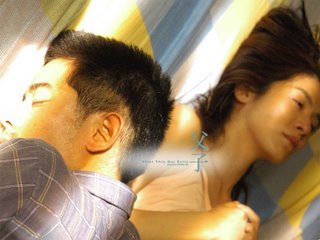
After This Our Exile (Fu Zi)

Dad and Mom


This film needs no introduction. The latest work from director-writer Patrick Tam, After This Our Exile took home honours from the recent 2006 Golden Horse Awards for Best Actor, Best Supporting Actor, and Best Picture, and after watching it today, it's no surprise why it did.

As mentioned in one of my recent reviews, the storyline of a movie is important, nevermind if the technicalities are great, because if the story doesn't engage, then it's a battle lost, in my opinion anyway. In After This Our Exile, the story is extremely simple, but it resonates deeply, and also because it deals with something very personal, very close, and perhaps, family ties always cut closer to home. After all, the Chinese title is Fu Zi, literally translated as Father-Son, which is quite unsophisticated if compared to the English title.

If you raised an eyebrow in Aaron Kwok's win for his acting in Divergence and thought he probably didn't deserve it, then his role as Sheng will win you over and justify his back to back win at the Golden Horse Awards. I'm sold. Gone are those teeny-bopper bad hair days and repetitive dance moves. Now, with maturity, he adds a certain gravitas to his roles, and kudos too to his willingness to take on unsavoury characters, instead of playing hero all the time. His dad is the perennial terror, one who blows hot and cold in a whim, full of false bravado, and never hesitant to raise a hand against spouse and kid. Uneducated, loud, uncouth, and worse, a habitual gambler, life for his family is difficult, both in material and emotional wealth. Yes, Kwok pulled off this character with aplomb, with subtle nuances, gestures, mannerisms and attitude all spot on, bringing to life a character you'll so love to hate, yet sympathize with at the same time.

And since the "Fu" played opposite the "Zi", and having both of actors pull off their father son relationship so convincingly, with great onscreen chemistry, it's no wonder too that 9 year old Gouw Ian Iskandar took home the Best Supporting Actor award as the Son. His childlike innocence will probably bowl you over with earnestness, as he holds his own opposite Kwok and screen mother played by Charlie Young. He doesn't come off as irritating, and is so much likable and vulnerable in character that you just want to give him a hug. Intuitive and smart, you'd come to love and pity his character very early in the story.

Charlie Young only had half as much to do as the other two leads, and without makeup, she manages to bring out that average every day weary look of a tired mother and wife who had enough. And herein, the conflict begins, from the beginning of the film. Other supporting cast include Valen Hsu and Kelly Lin, are kept to a minimum, thereby keeping the focus squarely on the principal cast.

As I mentioned earlier, After This Our Exile tells a simple tale with deep themes, and is able to draw out emotions from within you as it resonates. In what could be problems that households face when there's a gambler in the home, the movie sets to show these issues from the onset, with the breaking down of family ties and values, and the debt causing financial strain on the family. I guess opposition to our Integrated Resorts would see their arguments fleshed out here.

In what could be an oversimplification of the issue, gamblers = debts = strain in family relations, it is this domestic disturbance that ring out vividly. Broadly it can be categorized into two acts (no, I won't say anything more), but each act focuses on different aspects on the family relationship and dynamics. Toward the end, everything comes full circle, with the son experiencing exactly what the mom has gone through, and it makes the movie extremely poignant. It emphasizes the widely held notion that in domestic squabbles, it's always the children who suffer the fate of the consequences.

Brilliant cinematography and awesome musical pieces complemented the movie well, with plenty of nice piano pieces punctuating emotional moments. The pacing, though slow, is well measured, and Ipoh never looked more beautiful, becoming a character in itself rather than just another locale to shoot the film in. Attention to details are not spared, and the production brings about Malaysian flavour to it too. Some though I predict, may not enjoy the open end that director Patrick Tam chose to finish it with, but it will allow for post viewing discussion, loads of it.

My only gripe, as I just found out, is that the theatrical version now showing in theatres, is the watered down one. The director's cut, clocking in at almost 2.5 hours, get whittled down to 2 hours here, leaving certain scenes on the cutting room floor which were glimpsed at through a series of very quick flashback montage. I thought the film could have gone on and showed us more footage, especially on the father-son bonding (hinted from production stills), which I thought would have added a better level of the understanding about the dynamics of the Fu-Zi relationship.

The second movie this year which used the You Are My Sunshine song (the other is the Korean movie), After This Our Exile makes its way easily into my shortlist of favourite movies of 2006.

You are my sunshine, making me happy when skies are grey. You never know how much I love you.

Tuesday, December 05, 2006

Double Happiness Is...

... no, I'm not getting married, but this is a continuation from an earlier post, the day I got my Swordsman DVD.

It was a long shot, but it was worth a try. HK actress Cecilia Yip was in town as a member of the judging panel for this year's Asian Festival of First Films. Having seen her last Sunday at a screening was a surprise, because I thought the judges usually watch the films behind closed doors. And I regretted not following my gut instinct to bring along a camera, and my latest acquisition.

So while I was glad that she (and the other judges) were there for the closing film, Becoming Royston, for that entire night my thick skin dissolved. She was having dinner at the Arts House Cafe and I thought it wouldn't be nice to intrude when she's having her meal.

My jaw dropped when she and her friend(? manager? minder?) decided to sit at the empty seats beside me. Good opportunity to strike up a conversation you say? You bet, but somehow I stayed clammed up (yeah you can kick me now). Not that I didn't try to talk to her friend, but only something lame came out of my mouth, like

"Hi... is that Ye Tong...?"
"I think there's some resemblance" was the cheeky reply, used to perfection probably to fend off rabid fans like me.

Ooh... And Ms Yip was smiling at that reply (I tell you that smile can melt the sternest of hearts). The screening started soon after, given the almost 20 minute delay due to traffic and weather (yes, I sat there motionless and speechless), and who would have thought the fire alarm went off halfway through the screening as well.

It was not until the end of the screening, when everyone started to leave, that I mustered up enough courage to ask her: "Hi Ms Yip, would you mind if I get an autograph from you?"

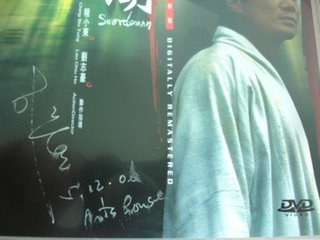
And she smiled (heart melt #2) and agreed. The best part is as I took out my Swordsman DVD, she was surprised and asked if it was new. I told her I got it some time back already (though technically it was a week old), and I watched it yesterday night too, extras and all, and Richard actually suggested to bring along that big pictorial to try my luck and get it signed. Too difficult to transport lah, was my reply to Ric. And I had to explain to her that no, I'm not deranged to be bringing along that DVD everywhere I go, just that I saw her last Sunday at the AFFF screening, and thought she would attend this one as well.

Anyway, here's happiness #1, that my DVD Collector's Edition of one of my favourite martial arts movie, got autographed by a principal cast member :-)


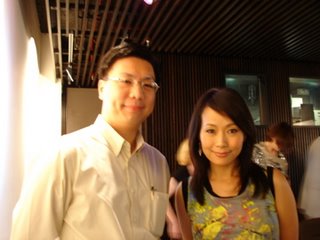
And happiness #2, was when she also agreed to having a picture taken with me


Cloud Nine fellas, I tell you, Cloud Nine!

[Asian Festival of First Films] Becoming Royston

I Jealous of Your Screen Time!


Probably the last Singapore film to make its debut this year, I actually had high hopes for Becoming Royston. But expectations is always a bitch, and I sincerely thought it fell short of its potential. The creative team of Randy Ang and Nicholas Chee (of Originasian Pictures) had won the 2005 Fly By Night competition with their lavishly produced 5 minute short film, I'll Live A Day For You, incorporating Stephen Chow's axe-gang dance (now the umbrella gang here) into the popular short.

Becoming Royston worked its publicity engine earlier in the year, through its website as well as the release of webisodes - little episodes of the film released on the Internet. It's a novel approach, and I was intrigued, though I stopped short of only 2 webisodes, hoping that I would be able to watch the complete feature film on screen some day. And yes, today marked the day that we're watching it for the very first time, something fresh out of the oven. Nicholas revealed that the DVD was pressed that very day. It's in widescreen format, though the subtitles were relatively small and at times difficult to read on the small screen at the Arts House screening room.

The story tells of a boy, Tan Boon Huat aka Little Shrimp (Alvin Neo), and his journey to discover and realize his dream. He stumbled upon the filmmaking ideal when he watched Royston Tan (the real mccoy, making a cameo) talking about his profession in a mock TV talk show, and starts to emulate him, from writing his own scripts to shooting random objects with his 8mm. Chance, of course, allowed for almost implausible happenings with certain recognizable artefacts, and I thought it ruined the idyllic, rustic setting established in the beginning.

For a first film, it looks gorgeous. If I have to rank the cinematography in local films for this year, this would be the contender to Smell of Rain's. Given that both had that artistic element to them, each take their time to establish shots and employ various techniques to incorporate into the narrative. However, I felt that the fade to black has been used too extensively - almost every scene transition is a fade to black. While it might work for small short webisodes, having it used throughout a feature length might be a little trying. There are shades of Wong Kar-Wai-Chris Doyle influences, with instrumentals accompanying slow motions in dialogue-less scenes, which again I felt was unnecessary at times as they seem to stick out without having first engaging emotions, nor requiring or evoking a response from an audience.

And here lies one of my gripes about the film, that its characters lacked a certain emotional depth to engage, and didn't allow much avenue for an audience to identify with them. The characteristics of the two protagonists are relatively weak and disn't allow for much growth - Boon Huat is your average drifter aspiring to pursue his dreams with nary a clue how to, and Ah Girl (Oon Shu An) is built from the typical "bad girl" mould who smokes, swears, steals, and engages in lots of sex. The supporting characters held a lot of promise, and their back-stories seemed interesting enough to lift the movie forward. However, they were totally wasted midway through the film, and are left forgotten, which is a huge pity.

I would rate the first half of the movie holding so much promise, and narratively more interesting than what the second half dished out, with hastily introduced characters like Marilyn Lee's journalist character being just there, but adding little function to the plot. You just don't care for them, and they don't allow you to even if you tried hard. Based on an original story by Tay Kay Chin, Becoming Royston lacked a strong, compelling and convincing storyline, and repetitive dialogues in dialect, while amusing the first few times it gets uttered, becomes unfunny after a while.

One of the scenes toward the end was quite cheesy, introduced to have its theme hammered home - that of daring to live your dream. I've always enjoyed outtakes when the end credits roll, but somehow for a pseudo-serious film like this with its sombre-like finale, showing the outtakes did feel a bit out of place.

Nonetheless, the technical aspects of this film is excellent, considering the team are first time feature filmmakers, and Becoming Royston is up for 3 awards at the Asian Festival of First Films - Producing, Script, Cinematography and Actor. Now all that's needed is a strong story to exploit the team's technical skills into making a film that I believe will make waves here, and perhaps internationally as well.

Keep Originasian Pictures in your radar, folks.

***

The screening was rated NC-16, and it was because of a certain sexual scene. In my opinion, it's much ado about nothing, but I guess the censors here deem it otherwise. Whether having it shown explicitly, or implied off-camera, probably subjected it to that non PG rating by their standards. Still, it could also be because of the swearing.

Monday, December 04, 2006

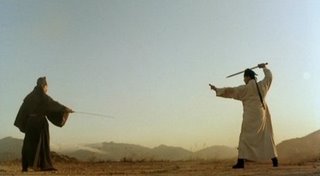
[DVD] Swordsman (Xiao Ao Jiang Hu) (1990)

Fight In The Sand


I grew up weaned on movies, and television serials from Hong Kong. And my affinity and liking for the martial arts genre, stem from old Shaw Brothers kungfu movies, as well as TVB Serials adapting works of renowned author Louis Cha - like Legend of the Condor Heroes (Felix Wong and the late Barbara Yung), Return of the Condor Heroes (Andy Lau and Idy Chan), The Heaven Sword and Dragon Sabre (Tony Leung), Demi-Gods and Semi-Devils (Felix Wong), and Ode to Gallantry (Tony Leung). Even today, there are countless of remakes from Hong Kong, Taiwan, China and even Singapore (which always never fail to bring on the laughs with its ridiculous costumes).

While drama serials enable the rich content to be translated to screen without losing much characterization, and allow for most of the plot lines to be told, it's a different case when movies are concerned. Filmmakers from Wong Jing to Wong Kar-wai have attempted to translate his works to the silver screen, but often achieved mixed results. It almost goes without saying that you can never condense Louis Cha's works into a two hour movie without slashing 90% of the story, and making sacrifices to plot and character development, sometimes even at the expense of characters. Staying true to the source is almost impossible, so certain artistic and pragmatic liberties have to be taken.

Huge stars often find themselves attached to projects based on Louis Cha's works, because of the potential box office success, and with it comes recognition and fame. However, the quality of works are debatable. Wong Kar-Wai had Ashes of Time, a conceived prequel story of sorts to the Condor series, using major characters of skilled pugilist, and imagining them at their younger days. Some have deemed it a load of mumbo-jumbo, while others hailed it as a masterpiece. You have those that infused loads of comedy, like Wong Jing's Kung Fu Cult Master, starring Jet Li as hero Zhang Wuji, in a movie adaptation of Heaven Sword and Dragon Sabre. This movie was the first of two parts, and was left with a cliffhanger from a sequel that was never made. Parodies like The Eagle Shooting Heroes by Jeffrey Lau were made, but these were easily forgettable movies.

Which brings us to Swordsman, or as the novel titled, The Smiling, Proud Wanderer, whom Chow Yun-Fat took on the title Linghu Chong role in a TVB serial of old. Swordsman is part of a loose trilogy of sorts, the sequels being Swordsman II starring an almost different cast in leading roles, and Swordsman: The East is Red, made solely to capitalize on the popularity of actress Lin Ching-Hsia who made her memorable comeback role as The Invinsible Dawn from the second movie. Amongst the three, Swordsman is still my favourite, even though Swordsman II had more fantastical fighting sequences, no doubt made more exciting by the charismatic presence of pugilist Jet Li. Swordsman: The East is Red, was largely wasted, and save for Lin, none of the other cast members returned, and had a totally unrelated story from the original medium.

Not that Swordsman stuck closely to the intended Louis Cha version. As mentioned, plot lines were compressed, and characters sometimes appear and disappear with hardly a fight. What worked, was how the movie managed to sample the spirit of the novel, and translate it for the screen. The script and plot was kept tight, and revolved around the intense search for a missing martial arts manual, called Kui Hua Bao Dian, which is known to give the practitioner extreme prowess, as demonstrated in the sequel Swordsman II, but with a price.

Double crossings, hidden intentions, quest for power - these are familiar themes which are played to perfection by the characters, save for one pair, our heroes Linghu Chong and Kiddo, who are caught in the web of intrigue. In short, the movie pretty much summarized the battles and craftiness of the characters in their thirst for the book, and ultimately, we see the disillusionment of Linghu Chong in matters of "jiang hu", as sung in the song Xiao Ao Jiang Hu.

And oh, the song! If there's a song that maketh the movie, Swordsman will immediately spring to mind. It's an infectious earworm, but what elevated its status rather than being just another song played during the credits or relegated to background music, was its involvement as a plot element, in the bonding of friendship, the expression of disillusionment, and also, being so integral to the development of the story, in the form of revelation of true intentions.

Naturally, since the song is important, the God of Songs of the time, Sam Hui, was casted as Linghu Chong. There were reported protests against the casting of Sam, because of his lack of martial arts background, but I would like to beg to differ. Yes he's not a natural pugilist, but don't forget, the characterization is key upon deciding who gets casted. His interpretation and portrayal of Linghu Chong, in my opinion, is spot on (miles better than Jet Li), bringing a dash of suave and impish slyness, together with strong vocals and that devil may care attitude. Stuntmen were probably roped in to handle the complex fighting stances, especially when Linghu Chong executes his Du Gu Jiu Jian (Du Gu's Nine Swords), a reputable and formidable swordsplay technique able to counter any attacks, but hey, more than half the martial arts movie out there, have stunt folk fighting in the place of actors.

The rest of the cast were also top notch, like Yueh Wah, Cecilia Yip, Cheung Mun and even Jacky Cheung in a rare villainous role, although it was a pity that for the sequel, almost all of them were replaced, yet by another strong lineup like Rosamund Kwan, Michelle Reis, Jet Li, and of course, Lin Ching-hsia.

With a rich, strong story containing the essense, adequate interesting fighting sequences, awesome cast and memorable song, it's hard to find what's not to like about Swordsman. Never mind the rumoured reports that director King Hu actually walked out of the project halfway, and had folks like Ann Hui, Ching Tsui-Tong, and even Tsui Hark himself amongst others take over in a collaborative effort, this movie delivers, and will forever remain one of my favourites of the martial arts genre.


Audio Visual:

This collector's edition, digitally remastered DVD is a gem. The visual transfers are great, and clear too, given the many night scenes and fights that the characters find themselves in. The audio however, is suspect. I watched it in the original Cantonese 2.0, and there are clearly signs of out of sync dialogue and mouth movement, leading one to suspect that some actors were acting using Mandarin, while others were using Cantonese. Nonetheless this discrepancy fades after a while, and didn't bother for too long. You can select the Mandarin track though, which also comes in DTS and Dolby 5.1.

DVD Extras:

2 trailers are included, each running more than 3 minutes long. The first is the original theatrical trailer which featured quite a number of the martial arts fight scenes. The other trailer is a recut, jazzed up trailer for the DVD, but offers nothing much else. Standard fare, these two extras.

And more standard fare are the photograph stills from the movie. I'm always puzzled why such stills are included, given that the stills are viewed from a television screen, doesn't really make much sense since they're static images. The photograph slide show, with about 20 photos, are pretty much the same content as the still photographs.

Before you dismiss the extras, the gems are actually the interviews. It's a pity that there's a lack of commentary, but I suppose having 2 interviews are at least some form of redemption. There's one with the composer James Wong, which is worth every minute of it, and the other with cast member, the current God of Songs Jacky Cheung.

Jacky Cheung's interview runs for almost 13 minutes, and contains many anecdotes including the sharing of his experiences of acting in the martial arts movie. He's more renowned for his songs and singing prowess, and it's of course a surprise that he managed to snag a supporting acting award for his role in Swordsman. I thought he put up a convincing enough performance as a scheming, double faced man.

But what's probably the best part is James Wong's interview segment, running 8 1/2 minutes long. Here he reminisce how inspiration struck him into composing that signature song with the use of the simplest of chords and combining them into the tune (the final cut is the 7th version), as well as sticking to his guns on the lyrics coupled with his arguments with Tsui Hark on aspects of the music. He also shared anecdotes on Sam Hui's style of working, and praised his delivery of that signature tune.

Sunday, December 03, 2006

[Asian Festival of First Films] A Hero's Journey

This year alone we have a number of documentaries made by local filmmakers being showcased - Singapore Gaga, Passabe and of course, A Hero's Journey. All the films have been shown during Cine.SG's screening, and Singapore Gaga has gone on with a small scaled commercial screening at the Arts House, playing to full houses in almost all the sessions. I would have caught A Hero's Journey earlier but the tickets to the Cine.SG screening was sold out, much to my surprise. It could be that Passabe perked interest in Timor Leste, and hence, director Grace Phan's documentary had some runway of information leading to its screening the week after.

But I suppose the reason behind that sold out screening, was because people were curious about the premise of the documentary. Timor Leste is one of the world's youngest nation, and in recent times, it fell prey to violence yet again, a period after the Indonesian occupation, and after self-independence was proclaimed amid the violence that erupted thereafter by local militia backed by Indonesian troops.

Probably one of the rare films made with the assistance of, sanctioned and even narrated by a head of state, A Hero's Journey traces the beginnings of the struggle for independence, of now President Xanana Gusmao's beginnings as a guerilla, to his imprisonment, and his presidency. He narrates to the viewer the background of this struggle, and of the challenges that lie ahead for this fledging nation. The camera follows him around as he visits villages seeking reconciliation and the seeking of closure from their past. Throughout we are presented interviews with both Gusmao, as well as villagers, and through them, try to understand the various issues that they face.

There was one line which the president said, which I thought summed up his feelings - that once as a guerilla your fight was focused and singular, and that is to win the war. But now as part of the government, your fight is now concentrated on many more fronts, each with its own urgency and importance, like education and the allocation of resources. It definitely is many more times as challenging to lift the standard of living of your countrymen.

And films such as these help us understand, as well as to take a glimpse into a land not seen by many. There are many picturesque moments in the film, which showed the beautiful scenery of the country, and the simple, yet happy, way of life. If the president's quarters is as makeshift as shown, you could expect that the conditions for ordinary folks may not be any better. Yet, these guys have found balance and peace, not through material wealth, but by reconciling and forgiving those who have done evil things against them. Peace of mind, comes from forgiveness.

This central theme of forgiveness rings through vividly midway through the documentary, despite having many different ideas presented, interwoven with the documentary footage of Gusmao's time in prison, as well as those taken during the violent massacres, during Gusmao's guerilla days, and even the reconciliatory visits made by Indonesia's military ex-headhoncho General Wiranto. While the ending was a bit of a tangent off the general feel of the movie - where a visit to an indigenous tribe was made, it just demonstrated the many excellent material that the filmmakers had gathered, and found difficult to decide what to put in, and what to leave out.

There were many questions which came fast and furious from the audience, and producer Edmond Wong was on hand to address those queries. Things like how much of the documentary is scripted, and how much is actually original ideas from Gusmao himself. Edmond explained that Gusmao had plenty of ideas discussed and statements made throughout the film shoot, and Grace had to find ways to gel those ideas together into a more coherent documentary, and they had settled on the strong theme of forgiveness.

One other question asked was whether the movie was made with the intention of an international audience or for local audience. While it's made to be released internationally to raise awareness, funds, and for people to learn more about the country, it's purpose, as far as Gusmao is concerned, is to show it to the locals, that through the movie, as a medium, it can bring its message across in an effective way. They haven't gotten around to dub it into the local dialects (since most of the locals are illiterate and it makes no sense to subtitle the film in the local language), but Gusmao had been unavailable, and also of the recent turmoil. But the filmmakers hope to be able to release this for the people of Timor Leste.

While other movies about TImor Leste had been banned in Indonesia before, the filmmakers were surprised that this one will make its way to the Jakarta International Film Festival, so that's probably gonna be a milestone. Do watch this if you have the opportunity to do so!

Trust The Man

The Table Talk


When I saw the trailer for this film earlier this year, I placed it under my radar to watch if it makes its way here. I would like to have loved this film, but try as I may, I just couldn't. Not that it's a bad film, but it had too much cramped into it, with subplots flying off in various directions, and the flow just feels too bloated.

It's been some time since we last saw David Duchovny on screen. I'm a fan of his Fox Mulder, but after the series ended, it seemed that he has difficulty securing regular appearances in movies these days. He doesn't seem to age, and his latest outing in this movie is testament to that, save for that bearded look toward the end. His character, Tom, is interesting enough as the sex addict (yeah, you read that right), who just can't get enough of the hot and heavy from his wife Rebecca, played by Julianne Moore.

For this couple, we look at their marital woes, or woes that exist but always swept and kept under the carpet. It doesn't help when husband and wife reverses roles, with him becoming a house husband with plenty of time in his hands, and she spending long hours away with her theatre rehearsals. And when an attractive divorcee comes into the picture, all hell breaks loose of course.

Written and directed by director Bart Freundlich (real life husband of Julianne Moore), the story contrasts this couple with another, that of Tobey (Billy Crudup) and Elaine (Maggie Gyllenhaal). They are your perennial long term dating pair, with one eager to tie the knot, while the other just being commitment phobic. The hairline cracks finally give way, and we go into deep examination of the doom and gloom, the familiarity and the taking for granted, your other half.

There's plenty of dialogue in this movie, but don't expect most of them to be funny all the time. No quality wisecracks can be found here. While some are humourous, they come off rather contrived. Many scenes are also set around the (dinner) table, which offers the perfect opportunity for the characters to get together and share their thoughts, being conveniently related to one another, through blood relations and friendship. What's interesting though, is the reminder constantly played throughout, about the need to be totally honest about each other, even though this will mean having to declare things you know will definitely hurt. A cry for help shouldn't be blown away.

Again there are plenty more scenes shot which didn't make it to the final cut, and the editing was not slick enough to cover up these open end hanging feeling between scenes. A whole host of supporting cast like Gary Shandling and Eva Mendes amongst others, get so minuscule a role, they just adds to the needless character count, and contribute to the fat not required in story development.

But if you think you're in need of some serious romance drama, and potentially the need to reaffirm your love for someone, or in the mood for some discussions about the various themes put across - of love, faith, lust and sex, then Trust the Man will be your clear choice this week.

Saturday, December 02, 2006

[China Digital Film Festival] A Time To Love (Qing Ren Jie)


How long will you wait for somebody you love? Will you hold on to that hope and have faith, or will you buckle at the uncertainties, and choose to move on? You'll never know until you're in it, and are forced to make some decisions. While you can decide for yourself, you'll never really know how the other half will fare, especially if it's long distance.

A Time to Love, starring Lu Yi and Zhao Wei as star-crossed lovers, adapts the basic premise from Shakespeare's timeless romantic tragedy, Romeo and Juliet. The references are countless, be it direct like the very cheesy replication of the famous Act II Scene II, or indirectly. As childhood sweethearts, their love for each other is forbidden by their respective families due to a mysterious feud between the heads of the households. So long as it remains mysterious, so too will their love be hidden away from their families, resulting in stealing glances, and meeting up in secret. But how long can this continue before taking its toil, especially when one turns out to be a high flyer and ambition gets in the way? Even the characters fit R&J to a T.

Lu Yi's Hou Jia is actually quite wishy-washy, afraid to express his feelings for his love, and is kept in his place by his wheelchair bound mother. Probably out of filial piety, given that it's a Chinese/Asian virtue, but having her dictate his life, is probably as pathetic as can be. There are times though, that as his character develops, it threads on dangerous ground just as the cad that Lu Yi played in Jasmine Woman, starring yet another Chinese actress who have made international waves, Zhang Ziyi.

Zhao Wei's Qu Ran on the other hand, is as strong in character as Juliet, the one calling the shots on how she wants to live her life, and to love who she wants to, despite her parental objections. Zhao Wei herself lights up the screen with her scenes each time, and no doubt her bright illuminating eyes contribute to that effect, expressing her fear, anger, loneliness, happiness, all rolled into one and projected through the windows of the soul.

The movie, itself based on a short story, contains plenty of cheesy moments that will probably be appreciated by the romantics, or cringe just about every general movie going audience. Familiar themes for romantic movies are at their element here, with beautiful camera shots setting up scenes of isolation, and of waiting, and bringing to life the love between our lovers. There is a sex scene (*gasp* it ain't so stuffy after all!) but you don't get to see much.

Just To Whet Your Appetite


There are some movies that perpetually shoot itself in the foot with its bad ending. You know, those that have an excellent build up, right until the finale, but destroys all the good work done with the very last frame. You can add this movie to that list of yours. While the non-romantics would have already rolled their eyes as the story progressed, those who are holding out until the end will probably be nodding in unison with its open ended third act, but unfortunately, that dumb final line had to appear as the end title. And no, it's not "The End", but by doing that, it robbed the movie of whatever shreds of credibility it tried to keep alive, and topped it with stinky cheese.

P.S. It's a pity that this movie only had less than 10 persons in the audience, one of whom is Kenneth Tan himself. Guess having two film festivals running side by side, in the holiday season of December, does take its toil on the attendance of festival movies.

Deck The Halls

Who's Your Daddy?


You know the Christmas season is coming when the theatres start to line up its Christmas themed movies. You have comedies like Deck the Halls, one for the romantics in The Holiday, and of course, going back to basics with the retelling of the birth of Jesus Christ in The Nativity Story.

The very first Matthew Broderick movie I've watched is Wargames, when I was a kid. And I thought he would have had quite a stellar career with his boyish good looks. Well, it's been almost 20 years, and that dude still retains his baby face, though now given age he's taken on roles of the family guy, and as Steve Finch, he's known as the Christmas guy around town, for his role in the committee for spreading the Christmas cheer. Until of course, his new neighbour, the Halls, move in, and innocently starts a rivalry with Buddy Hall (Danny DeVito), which in certain instances, look as petty as those squabbling neighours in the Joo Chiat area.

And family comedies like Deck the Halls are as predictable as they come by, with the setup of the dysfunctional characters. In the Finches, you have the straight laced Steve, the model mom Kelly (Kristin Davis), the depressed son Carter (Dylan Blue) and the coming of age daughter Madison (Alia Shawkat). At the other corner, you have the Buddy the father, with a penchant for giving up the things that he does, the ditzy mom Tia (Kristin Chenoweth, reprising a role so similar to her RV one as yet another blonde yodeling mom), and two, totally hot teenage twin daughters in Ashley (Sabrina Aldridge) and Emily (Kelly Aldridge), which are unfortunately, flower vase roles.

The feud starts when Ashley and Emily suggest to Buddy that their new home cannot be viewed from MyEarth (a fictional Google Earth clone), and to Buddy, one way to do that is to light up his home so that it could be seen from outer space. That's the primary premise, and naturally, by doing that, you disturb the neighbours, the Finches. So begins the one-up-manship between the two guys, egos bursting and all, as they outwit and try to outlast each other, much to the disapproval of their wives and kids.

It does make you think though, that in this spirit of giving and forgiving, that these two men are actually doing the direct opposites in upholding their Christmas values. Steve wants his (boring) family traditions to continue, and he does so in a very boorish manner, with his frequent complaining, whining, and sabotaging. Buddy on the other hand, steals. It portrays typical hypocritical behaviour that in your laughter, you're forced to think enough about whether you actually fall under the same category in this season of goodwill toward all men and women.

The flaws in the movie are obvious, such as the poor editing which dazzled itself during the Winterfest scenes. I suspect that a lot of footage containing various set action pieces were shot, and some discarded for time and quality, while the Who's Your Daddy joke just couldn't not to be included. Given its budget, cheap CG shots also distracted and took the mickey out of the fun factor.

Given that it's a Christmas movie, it definitely must have the feel good factor, which accounts for its implausible ending that cannot happen given time constraints, unless of course, you deem it a miracle. It's feel good, though some in the audience were manipulated enough to shed some tears at the end. And what of the message? It's obviously Love Thy Neighbours, and to relook into man made traditions that seem to stifle rather than make closer the valued family ties.

But as goodwill extended to this movie, although it'll never be a classic, will be the impressive light show sequence, as lights are made to dance in tune to the yuletide songs. One wonders who much time, effort and money went to create that show, which is this movie's pièce de résistance. And I appreciate that little clip from Meet Me in St Louis starring Judy Garland - watch that if you can.

Open Season

Whatever You Do, Don't Squeeze!


OK, this year alone probably saw a record number of talking animal animations, with countless of punchlines filled with pop culture references, and big name stars attached to the projects, that it's about time we give the genre a good break, rather than churning them out continuously with more misses than hits.

And Open Season, probably the last one on offer this year from a Hollywood studio, suffers from this glut, unfortunately. Heck, with so much similarities between the movies, you can even spot a familiarity or two from the storylines, taking a a leaf from one of the earlier flop - The Wild, in having one of its stars here, part of a popular animal attraction, and another part from Over The Hedge, where a group of animals must band together for survival and a fight against adversity.

The leads for Open Season are a domesticated grizzly bear who has its own teddy bear soft toy (don't ask), and a mule-deer with one half of its horn sawn off. An unlikely pairing, a "loser and a loserer", voiced by Martin Lawrence and Ashton Kutcher respectively. It's strange that there's a reversal of voice roles here, as Lawrence's Boog the Bear is uptight, while Kutcher's Elliot the deer is built in the same old wise cracking mould as Eddie Murphy's Mushu in Mulan, or Donkey in Shrek. In other words, Boog frequently gets punk'd by Elliot.

It's one of those recycled plots about loneliness, and having two misfits finding themselves in each other, relying on strengths from the other party in order to survive in new environments. A misadventure sees Boog go back to the wild, with Elliot in tow, and the two have to find a way to get back to civilization where Boog belongs. Along the way they encounter other critters in the woods of course, paving the way for some comedy and more recycled themes of bullies and the likes. Don't believe the trailers though, as the war between animals and humans, doesn't take up much screen time.

The sad part though, is that there aren't many funny moments to distract you from the rehashed storylines and subplots, but then again, it's a made for children movie. As always, there are some of the weaker characters which get used as punching bags, and here, this role belonged to the mindless rabbits, which some might find irritatingly adorable. My vote however goes to the nasty Irish-accented squirrels, defenders of their pine trees with their nuts, and in second place, those insane beavers.

At least the animals don't break out singing songs every now and then, though there are some nice musical numbers that went along with the movie. But all in all, this movie isn't as entertaining as, say, Over The Hedge, and neither is it as bad as The Wild. But don't say I didn't warn you if you find this a tad too boring.

Wait for the DVD, and rent it. But why did I watch this? I'm a sucker for punishment, that's why! Oei!

Friday, December 01, 2006

The Last Kiss

A Rosy Life?


When you're in your twenties, you feel invincible. Fresh out of school, and with a world of opportunities ahead of you, the general feeling is that nothing can go wrong. At least that's how I felt. And so far, nothing drastic has knocked me off my feet, or grounded my perceived progress to a halt.

That is, until you hit the big three-oh, and start wondering about a whole host of issues, like what you're going to do with your life, are you going to settle down with that someone special if he/she exists, and essentially, what the heck happened in the last 10 years which seem to just whizz by, as if the decade just passed by without any significant milestones. And the male characters in The Last Kiss, are about the same age as I am, and in this story, they take a long hard look and evaluate heir circumstances, albeit all from a relationship point of view.

Adapted from a Spanish movie L'ultimo Bacio with a screenplay by Paul Haggis (who also wrote the screenplays for Casino Royale and Flags of Our Fathers now out in theatres), The Last Kiss stars Zach Braff as Michael, our guy who's stuck at the crossroads of his life. Everything's fine and dandy, great job, hybrid car, and living in with his pregnant girlfriend Jenna (Jacinda Barrett). However, that contemplation of life, of what's next, and his disbelief about marriage, has forced him to seriously think about the future. He's unsure, and in his vulnerable state, gets very tempted by a younger, beautiful girl, Kim (Rachel Bilson) when she throws herself at him.

Yes, Rachel Bilson from TV's OC has followed in the footsteps of fellow OC hot babe Mischa Barton, playing yet another sweet nubile temptation in their big screen debut (Barton did her tour in The Oh in Ohio). As the seductress, her character totally loses herself in the company of Michael, and feminists in the audience would roll their eyes and find it hard pressed to find a valid reason to fall for that cad Michael, who is definitely tempted and should have stuck to his guns.

Although the spotlight is definitely centered on this story arc, there are a few others which focus on Michael's friends, all hitting their 30s, and each facing dilemmas in their own right. Chris (Casey Affleck) is not getting along with his wife, who's high strung from taking care of their kid, Izzy (Michael Weston) cannot get over his ex girlfriend, and is actually an obsessive wuss, upset at her ability to move on so easily, and Eric Christian Olsen as Kenny the hipster player who's totally non-committal. Interactions between the guys are limited though, and each potential short story arc brings forth potential unexplored in full.

But perhaps we have to leave it to the older folk to shed some light in this movie. Blythe Danner and Tom Wilkinson somehow light up the screen with their chemistry, as two elderly married couple who are at odds with each other, because of the lack of some tender loving affection showered upon the other. Harold Ramis makes a surprise appearance, and he's almost ballooned to twice the size since his lean Ghostbusters days.

I'd actually thought I could easily identify with the broad issues faced by the host of characters here, but given it's focus just on relationships, it was a little below expectations. Nonetheless, it's one movie whose themes do set you thinking, especially about the touchy issue on fidelity (hence, who's the recipient of your very last kiss?), and even then it doesn't end by making any bold statements, but it chose to sit on the fence.

Thursday, November 30, 2006

Sketches of Frank Gehry

From Squiggles...


Frank Gehry is the world renowned architect who designed the Guggenheim Museum in Bilbao, Spain. This documentary, directed by his friend Sydney Pollack, takes a quick look into the man himself, as well as to showcase some of the designs of the past 20 years or so, including the Guggenheim, which is given plenty of airtime.

Nearer to home, the Kerzner-CapitaLand's Sentosa Integrated Resort bid boasts of having its architecture designed by Gehry. Response has been mixed that it resembles one of his earlier pieces, but hey, it's Frank Gehry, and having one of his designs here, if it gets awarded, will be one heck of an attraction in itself.

... To This? The Sentosa IR Bid


Gehry mentioned during the interview that Pollack was given the nod to do the documentary was because of his lack of knowledge in the field. Perhaps it's because coming from the outside, he would be able to provide a fresh perspective into how architecture is viewed, from a layman. There's nothing much to shout about in this film, except to drool at the various eclectic designs and buildings Gehry built, and to go behind the scenes to try and pick his brain about the processes and idiosyncrasies he lives by.

And watching the master at work is amazing. From his squiggly sketches, they evolve into grand monuments, often undergoing countless of changes on the fly. There are plenty of hacks on models, and the amount of material spent making these models is simply staggering. It's no wonder he has a dedicated team of professionals working under him, and together they create art. I'm also impressed by Gehry's vast knowledge on materials, as they are equally important in bringing to life the designs from paper to the actual building.

Watch this documentary if you want to have a glimpse of how Frank Gehry goes about his work combining art with architectural design, and of the little nuggets of information he shares about his work and design philosophy, as well as a rare glimpse into this life from interviews and dialogues with colleagues and friends.

Now I'm rooting for the Kerzner-CapitaLand bid, just to have a Gehry designed building on our shores :-)

Wednesday, November 29, 2006

Flags of Our Fathers

One Moment in Time


I nodded in agreement when it was mentioned a single photo taken during combat has the power to make or break a war. At a time when the war chest is drained and the battle seemed to be drawn out longer than expected, you need public support to cough out funds and make donations to the manufacturing of arms. In the dying days of WWII, that photo you see above, gave reason to galvanize the American public into making donations for that final push. Now think Abu Ghraib. Nuff said, on its adverse impact to the war machinery.

For WWII movies, the Pacific theatre has arguably fewer number of films made by the West, especially those whose focus is on the ground troops, as compared to the European theatre, and possibly could be due to the availability of locales, as well as budget and (non) permission to film at the actual place. The Iwo Jima here is a substitute backdrop, not the real Iwo Jima with black beaches that you can see right after the end credits roll, as if in silent meditation of the soldiers on both sides who had given up their lives fighting for their cause.

And the Battle of Iwo Jima had its historical significance given it's the first landing of Allied troops on Japanese soil, and one of the bloodiest yet with high casualties on both sides. It also opened up the American eyes to the tenacity of the Japanese troops and their relentless defence of the homeland from invasion, in a Digital Domain CGI-created massive naval beach landing. Those looking for recreated battle scenes will probably not be disappointed with the level of detail shown in Flags, like the weapons, and the infamous use of flamethrowers to smoke out hidden troops in bunkers.

But this movie is not an all out action film. It's not a macro look at how the Allies secured their first foothold in Japanese soil. Rather, it takes a very personal look at the surviving men who hoisted the American flag over a prominent knoll in Iwo Jima. While there are countless of versions of the circumstances surrounding this lifting of a symbol, be it for morale boosting purpose, or politics, or for abstract ideals like hope, the definitive version as recounted in this story is actually quite ordinary, fueled by a mix of human desire for something monumental, as well as the listening to orders to a T.

Told in a non linear fashion with flashbacks and voiceovers, it is extremely difficult that you'll be bored by the movie, unless your expectations have been set the wrong way. There is plenty of material and themes that the movie touched upon, although it can be argued that each doesn't necessarily have enough focus, issues like racism and prejudice. What makes this film compelling is the story of the survivors, being whisked back to the States to be part of propaganda to raise funds. Accuracy and accountability take the backseat against the hail of heroism, and it evolves very quickly into a media circus.

Flags examines the lives of those in the photo who survived the battle, their reluctance to be called heroes, the demons that they faced while on the battlefield, the constant reminder to kill or be killed, the lies they have to tell to sell, and their sense of morality sacrificed for the lesser of two evils. Being soldiers, they have to do listen to orders, even if at the moment, it sounds absurd (I believe those who have been through service in the armed forces will agree on this). It is the conflict, and the need to lie through their teeth, which makes it all the more a sorrowful struggle, especially when you have to deny a fellow brother his moment of recognition, and denying his family the need for closure.

And of course, we all know how fickle the press can be. On one hand they can praise you, on the other, someone's always looking at ways to demean and cast doubts. Flavours of the moment, potshots of controversy like whether the picture was staged, ring to mind that icons can never escape from the cynical eye. Politicians, rich businessmen and the military brass too are cast in none too positive light, as they get portrayed as men who like association with power, fame, and glory.

There are times when you'll do a double take on the cast. Adam Beach, who plays Native American Ira Hayes, also played a private in another WWII movie, fighting against the Japanese army in the Pacific theatre of war, in John Woo's stylized WWII movie Windtalkers. Barry Pepper, as Mike Strank, also an alumni of war movies, starring in Spielberg's (who serves as producer here) all too familiar Saving Private Ryan set in WWII, and alongside Mel Gibson in We Were Soldiers' Vietnam. In war movies, the sniper, commander and medic are roles which are easily made popular, and Ryan Phillippe had his role cut out for him, as the never-say-die combat medic John Bradley, whose son wrote the book this movie is based upon.

Clint Eastwood again never ceases to amaze me. Here's the star of spaghetti westerns, Dirty Harry himself, who has aged but still showing no signs of slowing down. Like fine wine, he has started to show his talents in the films he makes, and award winning critically acclaimed ones too. But what I'm really pleasantly and thoroughly enjoyed, is the score that he wrote for Flags. It's restrained, yet powerful, kept simple in instrument, yet never lacking in grandeur. Being a filmmaker is one thing, but having contribute to a highly effective score complimenting the movie, is another. Not many can do that.

Flags of Our Fathers is a must watch, and I'm already eagerly anticipating the companion movie, with viewpoints from the Japanese, fighting the same war, in Letters From Iwo Jima, and it should be equally powerful.

Tuesday, November 28, 2006

Happiness Is...


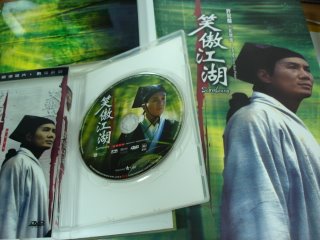
... getting one of those out of print DVDs at a discounted price, with a freebie included as well, the Sam Hui King Sized Pictorial containing stills from the movie.


I'm a fan of the martial arts genre, and Swordsman has a special place in my heart because it actually renewed my faith in the genre, and broadly, in Hong Kong movies as well. Given it's length, I was surprised that I could be engaged for a good two hours, where usually the typical duration of a HK movie will be around 90 minutes.


Also, it's based loosely on a novel by Louis Cha, who wrote some of the most popular martial arts novels out there, and have characters whom most are familiar with. I was intrigued by the shenanigans of all the martial arts sect when they congregate and try to out scheme one another to obtain the secret martial arts manual, and enjoyed THAT song being played again, and again.


Already, being able to watch it in its original Cantonese language track is a big bonus, given that the first time I've watched this was in Mandarin, on a video tape recorded from television, so you know with each viewing, the picture quality will degrade.

So until I really find some time and get down to watching this in its full glory, here's a snapshot of my latest acquisition :-)

Monday, November 27, 2006

Deja Vu

OK, I'm a Denzel fan, so the review might be slanted. I'm OK with Tony Scott's quick cutting style, so I don't suffer from the induced headaches that people complain about when watching his films. I enjoyed their collaboration in Man on Fire and Crimson Tide, so hell I'll probably enjoy Deja Vu too, which I did.

One warning though, despite the cheesy trailer where the opening credits repeat themselves, this film has a bit of hokey physics used to sustain plausibility. So please suspend disbelief, and oh yes, don't go looking for the plot holes because like all time travel related movies, they always exist.

Adopt the singular viewpoint and perspective of the protagonist, and you're in for a weekend popcorn ride.

To read my review of Deja Vu at movieXclusive.com, click on the logo below:


To read my review of Deja Vu at movieXclusive.com, click on the logo below:

Saturday, November 25, 2006

Saw III

The Master and Apprentice


Jigsaw's back! But this time the modus operandi is slightly different. In what was a game of pain, life and death, this time round it seems that there's an overconfidence that the unfortunate prey will not get out alive. Hence the death traps being literal.

But of course those who have not watched Saw II, will not know the suggestion at the change in MO. In order not to spoil it for you, I shall not mention a word, but hey, even without watching Saw II, there're ample flashback scenes, and newly created ones, to bring you up to speed. But trust me, watching the second film first before this, will help bucket loads, as it picks up directly where the previous film left off, with the return of characters played by Dina Meyer and Donnie Wahlberg.

Like the previous movies of the franchise, you have those elaborate devices for those sick games that Jigsaw likes to play with seemingly innocent men and women, chosen for not valuing their lives, and wasting it away. Through such games, Jigsaw's warped aim is, for those who survive, to learn to appreciate life itself. Then again, just how many do survive, since to do so calls for sacrifice, often pain inducing in a massive way in a race against time.

However, while the litres of blood continue to flow, the devices and plans here tended to be below par. Sure they're sick, but this time it really stretches it a little. Things happen to fall in place, and well, they just do. There seemed to be a bit of borrowing from Hannibal, with the use of boars (although dead ones here) and not since that film had I seen the power drill put to good use, with that unforgettable sound of the spinning drill. That skanky toilet makes a comeback too, and it probably ranks up there with toilets from Trainspotting and Crazy Stone.

You can guess the direction of the film's narrative, predicting where it will head, and how, but what you probably can't guess right, is the rationale behind what's happening, the Why, until the answers are revealed at the end. It'll also put to rest some of doubts and queries left hanging at the end of Saw II, and in a certain sense, Saw III wraps up the trilogy. Unless of course there is talk about making another film on the now cult figure Jigsaw, which will have the franchise follow the footsteps of the in-thing to do nowadays - the prequels.

While there are new characters introduced, it's kind strange that we do not care much about them, except to silently bet if they would be able to survive their ordeal. Perhaps gore movies are such, that an audience doesn't care what happens to them so long as blood is shed and bones are broken. Perhaps the influx of gore movies, each one trying to outdo the other, makes us just baying for blood to be shed by the characters, and nothing else.

So for those who have already watched the first two, this one will bring everything to full circle. And I can't get that all too familiar tune, which is played each time Jigsaw reveals his intentions, out of my head.

[Cine.SG] Medium Rare

I remembered watching this in the cinemas when it first came out. Actually it turned out to be one of those family cinema outings, and the decision to watch this was my Dad's. I tell you after this dud, he's just about sworn off watching any local productions, even up until today.

If anything good has resulted in this expensive S$2 million flop, then it is the lesson learnt in how not to make a movie. Looking at the cost, I'm not too sure where all the money went, given that local movies today, of better quality, don't cost that much. It has all the right ingredients inside that points to a flop, starting with the pandering to the caucasians in offering them lead roles. Back in those days, "foreign talent" meant so long as not asian, they're a shoo in as "stars", even though almost everyone here have not heard of them before.

First, the director Arthur Smith, whose directing skills are as generic as his name. With probably no film credits to his name, he's suddenly the man suited to helm the movie. The lead roles of Daniel Lee the Asian medium and Beverly Watson the photo-journalist, went to Dore Kraus and Jamie Marshall respective. Dore who? Precisely. His only claim to fame is the Australian remake of the Ultraman television series, where he's the human alter-ego of that legendary Japanese hero. I've watched that series when it aired here, and it was bad. Jamie Marshall probably was a nobody then, and probably is a nobody now, no thanks to this turkey.

Notable local input to the movie are actors who were unrecognizable those days, and relegated to support roles. Like Beatrice Chia as a mad woman possessed, Neo Swee Lin as a nurse receptionist, and even cameo king Lim Poh Huat is spotted in a non-speaking by-stander role. Margaret Chan, a food critic, employs her skills together with Rani Moorthy (who again?) to come up with a script that's based loosely on the notorious child serial killer Adrian Lim (I'll come to that later), and naturally, wrote in roles for themselves, and for Margaret Chan's daughter Clara. Real life mother and daughter get to play siblings here, and their chemistry onscreen is just so wrong.

The characters are so cardboard and hollow, and are made worse by wooden acting throughout. At some points the facial expressions seem to take a life of their own, with so much of exaggerated lip movements, stares and eyebrow twitches, it feels like a bad wayang. The lines of dialogue are horrible, and poor speech delivery made it all so cringeworthy. It's no wonder that none of the actors, or the scriptwriters, got offers again. Their amateurism shone right through.

Perhaps it's because of the lack of courage, that this film, about killings, steered clear of reasonable violence, leaving what you have a laughable effort. You have the drinking of blood out of vials, a seduction scene where a razor is used to cut a boob so that the medium can suck it, but the cameraman, so focused on the boob, failed to pan the camera upwards so that the fake action of cutting the breast would be unseen - this scene is so bad you just got to see it to believe. Wanting to infuse some sex into the plot, became actors embracing and falling down out of the camera view. Such is how bad the production is, and is indeed very mind boggling.

It also probably started the trend that if it's a Singapore film, you must have a shot of that Singapore riverfront skyline, and the mix of different ethnic costumes worn by characters. I do appreciate the former though, as it shows to a new generation of locals how the now famed skyline actually looked like in those days, with its sparseness, and the UOB skyscraper under construction. Shots done today of the same will be eclipsed once the Integrated Resort and Marina Bay city centre are up, and it serves as a good snapshot of a developing skyline.

And what of the plot you say? I think looking back in hindsight, saying that it's loosely based on Adrian Lim's cult killings of two children, is wrong. Besides the medium occupation, sex and his mistresses, there isn't any inkling of remote resemblance to actual incidents. And I'm not sure if anyone local would want to make a movie out of him anyway. The movie's also peppered with so much hokey spirituality that come alive, as audiences will probably groan in pain each time some fortune cookie inspired lines come spewing out.

Those involve in the editing too are plain lazy, as scenes feel disjointed, and looked more like individual short films spliced together with plenty of product placement and balls carrying. Someone ought to have said this is not a bloody advertisement for Pan Pacific Hotel, even though they are one of the sponsors. You have lingering shots of the building, given a full tour of the facilities from the suite to the gym to the pool to the restaurant to how friendly the reception staff are at their counter. God, give me a break! It's a movie, not some corporate in house video!

But truly, you have to admire the courage of those involved in the movie, as they try to entertain with many scenes so unintentionally funny. I'm not sure what ran through their minds, and some form of sanity check is required if they truly believe they're not making a comedy. Bad directing, script, acting, soundtrack, editing, the list goes on, and if the Razzies would be applicable here, this movie will own them all.

Only for serious film buffs wanting a piece of local cinematic history.

9:56 (APT)

Just About What's Beautiful In The Movie


This is a movie from Toilet Pictures. If the name of the production company is any indication how stinky a movie is, then this would be it. I think I'm not really a fan of horror movies, not that I'm chicken, but rather this year alone, I haven't been genuinely spooked by what's on offer so far, be it from the West, or from Asia. 9:56 is no different, great premise, but poor execution, relying on cliched techniques (I think these are the only tools of the trade available?) to try and elicit some heart thumping moments.

Se-jin (Ko So-young) is a lonely career woman, who one day notices that some apartments in the block of flats opposite hers, undergo blackouts simultaneously at precisely 9:56pm everyday. No, she's no voyeur, but a series of unexplained deaths in the neighbourhood, including one which she encounters herself on a subway, start to draw her deeper and deeper into the mystery surrounding these deaths.

With horror movies, there's always a pseudo-logical explanation within the movie about how the spooks come about. That's just about the most interesting thing that happens in the film, the unravelling of the "Truth", although it won't take seasoned film lovers to guess the plot halfway through. Which of course makes it a very unsatisfying experience watching this movie.

There's a myriad of characters like the wheelchair bound girl, and the neighbours who take turns to care for her, as well as a schoolgirl, detective, a mentally challenged boy and a spooky train commuter. But following genre formula, these folks are there usually as fodder for deaths, or in this case, pointless red herring characters whose sole aim by the filmmakers is to mislead the audience, nevermind if they convolute, or add little to forward the plot.

And don't get me started on the techniques employed here. Quick cuts, sudden appearances, long hair ghouls (ahhhhhhh, so passe!) who can't move properly, copious amount of blood like it flows down a mountain for free, and the list goes on. But credit to the sound engineers for creating some ear piercing bone crunching sounds used each time the spooks move, though it seems like a one trick pony.

Don't waste time on this, even if you're a horror fan. It's a complete waste of a promising premise, and in the end, you feel like you've just be taken on a ride. A very long and painful one to endure. It's high time for some innovation in this genre, otherwise one film will easily look like another, with ugly long haired monsters moving funny but with the ability to make sudden appearances accompanied by loud sounds. Oh, and can someone oil those doors while they're at it as well.

Friday, November 24, 2006

Happy Feet

I Believe I Can Fly


There was a documentary last year which made waves both critically and at the box office. It was a celebration of nature, of life, danger, and death as seen through the eyes of Emperor Penguins in the Antarctica. If you had seen that documentary, then the first 10 minutes of Happy Feet will be familiar territory, as it probably summarized a whole lot of the mating game, into the introductory act.

Happy Feet tells the story of an offspring Emperor Penguin of Norma Jean (voiced by Nicole Kidman) and Memphis (Hugh Jackman). With that distinctive mole placement and swagger, it's actually Marilyn Monroe and Elvis done as animated feather friends, romanticizing each other and eventually have a son aptly named Mumble, born with a defect, save for those distinctively sky blue eyes of Elijah Wood. A heart song is what the Emperor Penguins use to attract their mates, but true to his namesake, Mumble can't sing for nuts and can only, surprise, tap dance, much to the chagrin of the conservative elders.

It's perhaps a given that those cute baby penguins which melted the hearts of many in March of the Penguins, get featured so prominently here in Happy Feet. Milking them for what they're worth, this movie pours in a lot more crowd favourites like dance. So you have yet another animated movie in this year's glut of offerings, in yet another movie about dance, a dash of comedy fused with familiar songs weaved together in a medley, and voila! Instant formula for success!

I must admit I was initially apprehensive that Happy Feet will be able to pull it off and had somewhat low expectations, given some mediocre Hollywood animated movies being produced. But true enough, I was sold after 10 minutes. The animation is photo-realistic, and probably is the next best thing of having being in the Antarctica, or watching the real one on screen. If the animals in the movie quit talking, you might just think that they're for real.

The characters too manage to endear themselves to you, with Robin Williams staging a coup with his voice performance of two penguin characters, one a smooth talking leader of a pack of Adelie penguins with Latino accents (their antics reminiscent of those in Madagascar, only a lot more laid back), and of a know-it-all Guru who answers any questions in exchange for pebbles. Brittany Murphy can sing too, as she lends her voice to Mumble's love interest, and THE babe of the colony, Gloria. Hugo Weaving too is in the movie, and so is the late Steve Irwin. It's no wonder that at the helm of this movie is director George Miller, also an Australian (say, there's quite a number of Australian's lending their voices here)

While it's generally a feel good movie, there's a good portion of the movie well hidden away from the trailers, in case you have the nagging misconception that there's nothing too interesting about watching a story of an underdog outcast working his way, cutting across discrimination to win the girl of his dreams. At one point, I thought the movie could have gone the way that Steven Spielberg's AI had gone, because it certainly felt that way. Also, there's a very rushed message on conservation, and in fact, the finale felt that it got truncated just to end the way it had.

Christmas season's coming, and a tale rooted in family ties, friendship, and the return of the prodigal son, makes it satisfyingly enjoyable. Parents would probably check out if the toy stores carry baby penguin plush toys. Should be a hit with the kids, after the movie.

Happy Family is a Sex Bomb, Cute Kid, and Elvis!

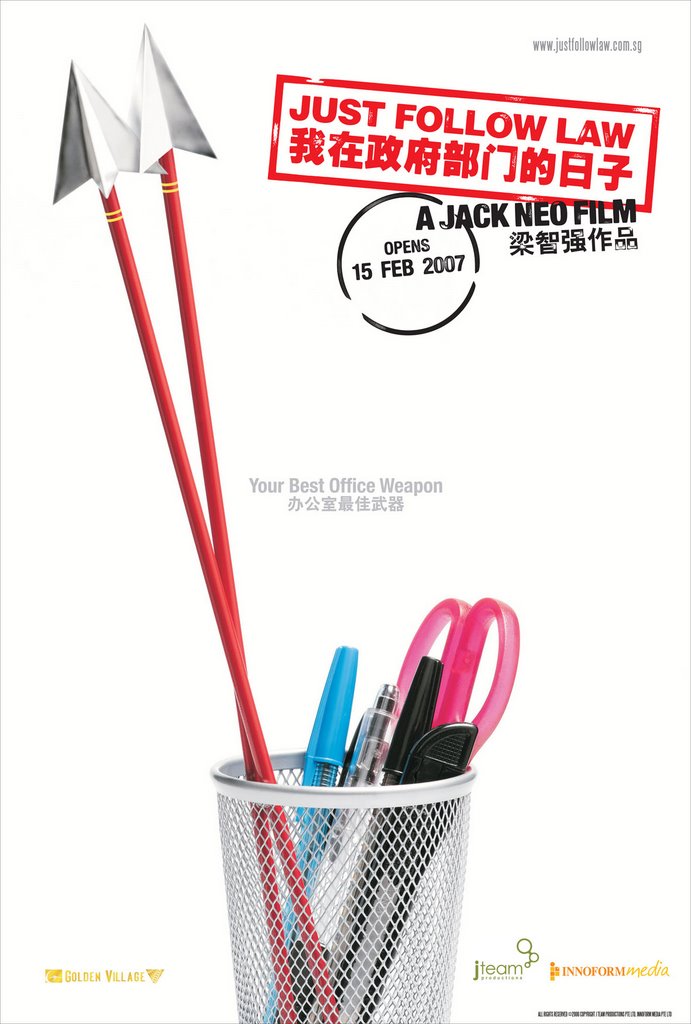
Just Follow Law - Website and Trailer


Jack Neo is one of Singapore's prolific filmmakers, and arguably the only one whose movies are consistently making decent box office returns. Starring familiar faces from television, Fann Wong (Shanghai Knights) and comedian Gurmit Singh, Jack is once again taking a satirical look at the civil service in Singapore with his new movie, set to make its debut on 15 Feb 2007.

Official Website and Trailer

Related Posts Plugin for WordPress, Blogger...